

Why 81% of B2B Buyers Decide Before They Talk to Sales (And What It Means for Your Win Rate)
Your reps are not closing the deals you think they are.
By the time the buyer books a demo, the decision is already 80% made.
Read that again.
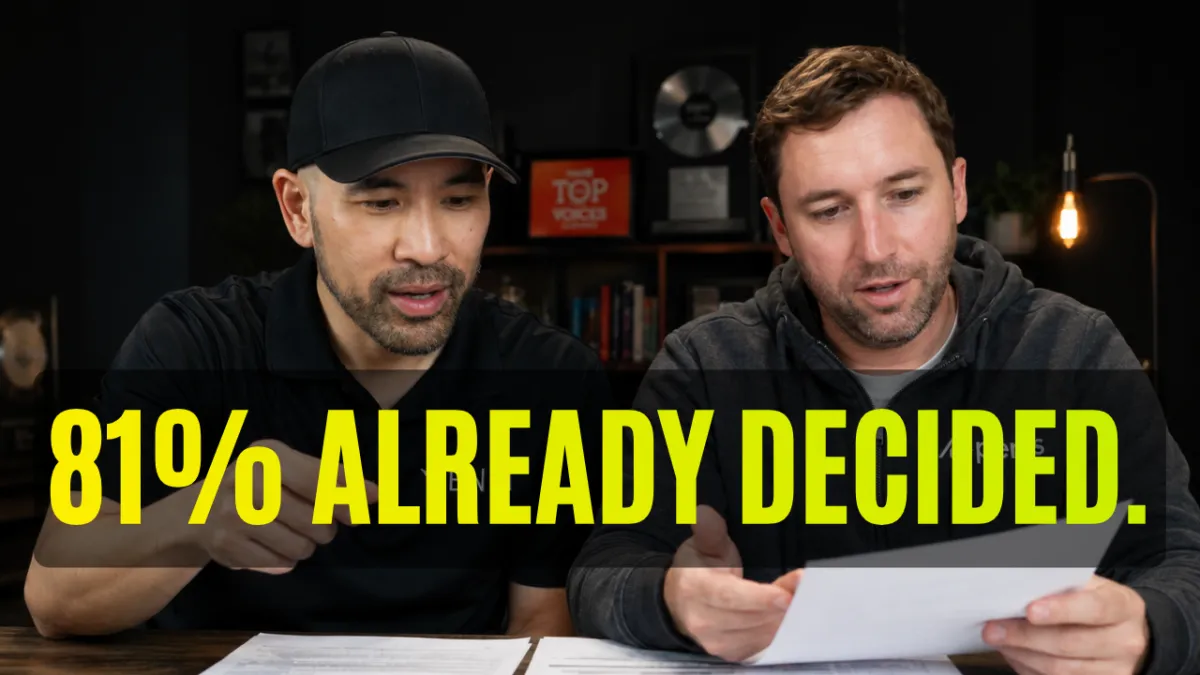
81% of B2B buyers pick a vendor before they ever talk to sales. They read the reviews. They text their network. They sit in three Slack groups asking peers what tool actually works. By the time your rep sends the calendar link, the buyer is not evaluating.
They are confirming.
That single shift broke the entire funnel most B2B sales orgs are still running.
I sat down this week with Braydan Young, the co-founder of Sendoso who scaled the gifting platform past $100M in funding, and now the CEO of SlashExperts.
Braydan built SlashExperts specifically because of that 81% number. He saw it from inside Sendoso, watched it kill deals he should have won, and built the company that fixes it.
What follows is the operator-level breakdown of what he laid out in our conversation, and what I see every day across 700-plus client engagements at Venli.
What Is the B2B Sales Win Rate Problem?
The B2B sales win rate problem is the gap between discovery and close.
Not the gap between cold call and demo.
Not the gap between SDR meeting and AE handoff.
The gap that lives inside the deal cycle, after the buyer has already self-qualified, after the demo has run, after everyone has nodded and said this looks great.
That is where 80% of your revenue dies.
Most B2B sales orgs sit at a 20% win rate or worse from first call to closed-won.
That number used to be tolerable in a market where pipeline was cheap and buyers were patient. Both of those are gone. The cost of acquiring each opportunity has roughly tripled in the last five years, and as Braydan pointed out in the conversation, the buyer has shifted 81% of the decision to a stage your rep is not even invited to.
The orgs that win in this environment stopped trying to fix the top of the funnel a year ago.
They are engineering the middle.
Your Rep Is No Longer the Pitcher. Your Rep Is the Project Manager.
The most expensive thing your reps are doing right now is pitching.
Braydan put it cleanly: by the time you are on a demo with somebody, they already want to choose somebody. The question is whether it is you or a competitor.
There is rarely a third option.
The buyer does not need a pitch. They have already pitched themselves.
They watched the comparison videos. They read the G2 thread. They DM'd a peer at a similar company and asked which tool actually works. By the time the demo starts, they have a leading vendor in mind and a quiet plan to back into it.
What they need from your rep is something almost nobody is training for.
They need help selling your product internally.
Braydan's framing on this was sharp. The rep's job, in his words, is to help that person sell it internally. That is the majority of the job. Not the pitch. Not the discovery. The internal sale.
They need to convince a CFO who has never seen the demo. They need to defend the choice in a procurement review. They need to manage seven other stakeholders who have opinions but no context.
That is where the deal is won or lost.
Your rep is the only person who can run that play. And if your rep does not know that, they are still pitching to a buyer who decided three weeks ago.
This shift changes everything. What you hire for. What you train for. How you compensate. What you measure.
The orgs that have not made that shift are running 2026 deals through a 2018 playbook and wondering why the forecast keeps missing.
The Three Moves That Separate Top Reps from the Rest
Across 700-plus clients at Venli, the reps who consistently close in this environment are doing three things almost nobody trains for. Braydan named the same three independently in our conversation, which is the cleanest signal I can give you that this is not theory.
1. They map every internal stakeholder before stakeholder two appears in the conversation. They do not wait for the buyer to mention the CFO. They surface that person on the first call by asking how decisions like this typically get made internally. Then they get permission to talk to that person directly.
2. They drop social proof at the moment of internal doubt. Not a slide of logos. A live customer in the same industry available for a 15-minute call. This is the entire premise behind what Braydan built at SlashExperts. The deals that use it move four times faster and run bigger. Most sales orgs already have customers willing to be references. Almost none of them have systematized actually using them.
3. They surface deal risk while the deal is still open. Most reps sense when a deal is slipping but do not address it head-on. They assume the issue will resolve itself. It does not. Top reps name the risk on the call, in the email, and on the deal review. They are paid to surface friction, not to hide it.
Why Your Best Reps Need You to Get Out of the Way
There is a second pattern from the conversation worth pulling out, because Braydan called it out from his own seat as a former operator and current CEO.
Your best reps are not failing because they cannot sell. They are failing because the rest of the company keeps interrupting them while they are trying to.
Marketing wants an update. The CEO is pinging them about the big logo in the pipeline. Finance is sending a 14-step deal desk approval form for a 10% discount on a $400K deal. Procurement just kicked back the redlines for the third time.
The rep who should be on demos and follow-ups is now in a Slack thread with three departments defending a deal she has not been allowed to actually work.
Braydan's take on this was the strongest line of the episode: the manager's job is not just to help close deals. It is to make sure the other teams get the hell out of the way. Most managers spend half their day defending their reps from internal noise, and the ones who do it well see immediate compression in deal velocity.
The fix is straightforward. Send weekly updates upstream so the CEO does not need to ping the rep. Cut the deal desk for anything under a clear policy threshold. Let the rep run the deal and trust the rep to surface what actually needs an executive in the room.
The orgs that get this right see immediate compression in deal velocity. The orgs that do not are paying their reps to spend half their week defending themselves internally.
How Long Does It Take to See Results From Fixing the Mid-Funnel?
In the programs I run, measurable movement on win rate shows up inside the first 30 to 60 days. Not a quarter. Not six months. One fintech client cut new-hire ramp from 14 months to 6 months and saw win rates climb 47% inside two quarters. The reps did not change. The system around them did.
Braydan's customers see a similar curve on the peer-validation side. Deals that used to take four months close in one. Not because the rep got better. Because the buyer finally got the social proof they were going to look for anyway, delivered at the moment of internal doubt instead of three weeks later from a friend on Slack.
Frequently Asked Questions
Why is my B2B sales win rate stuck at 20% even though my pipeline looks healthy?
A healthy pipeline with a low win rate is the textbook sign of a mid-funnel problem. The leads are coming in. The demos are happening. But somewhere between disco and close, deals are stalling because of internal buyer-consensus issues your reps are not equipped to manage. As Braydan noted in our conversation, 81% of buyers have already chosen a direction before the call. That means the rep's job is no longer to convince. It is to help the buyer win the internal sale. Reps trained for the old motion will keep producing the old result.
What is the difference between a top-of-funnel problem and a mid-funnel problem?
A top-of-funnel problem shows up as low pipeline volume, weak SDR output, or poor lead quality. A mid-funnel problem shows up as healthy pipeline with low conversion, slow deal velocity, and forecast inaccuracy. Most sales orgs default to assuming everything is a top-of-funnel problem because top-of-funnel is easier to measure. Mid-funnel issues require diagnosing the system between disco and close, which most internal teams cannot see because they are inside it.
Why does adding more SDRs not solve a low win-rate problem?
More SDRs add more leads. They do not change what happens after the lead converts to a meeting. If your win rate from disco to close is 20% and you double your SDR output, you have doubled the cost of acquiring opportunities you are still losing 80% of the time. The constraint is not lead volume. The constraint is the system between first call and signature, and that is what has to be re-engineered.
What should a CRO do if reps are getting interrupted by internal teams during live deals?
Two things. First, install a weekly deal-update cadence that goes upward to the CEO and finance so they do not need to ping the rep directly. Second, set clear policy thresholds for deal desk and procurement involvement so reps can self-serve inside guardrails for routine deals. Braydan's framing on this was direct: the reps who are golfing three days a week and closing seven figures are not doing it because they are lazy. They are doing it because their leadership has cleared every internal blocker out of their way.
The Bottom Line
Your reps are not broken. Your sales system is. The 81% number Braydan opened with is not a marketing stat. It is a signal that the entire shape of B2B selling has shifted, and most orgs are still optimizing the part of the funnel that no longer matters most.
==
If you lead a B2B team of 5 to 25 reps and you want to know exactly where your win rate is leaking, the Executive Snapshot is built for you. Forty-five minutes. Top three leaks. One-page memo you can forward to your CEO. Start here.
For the full conversation with Braydan, including his take on what dies in B2B selling over the next three years and why he believes every booth at every conference should be staffed by customers instead of salespeople, watch the episode embedded at the top of this post.


