


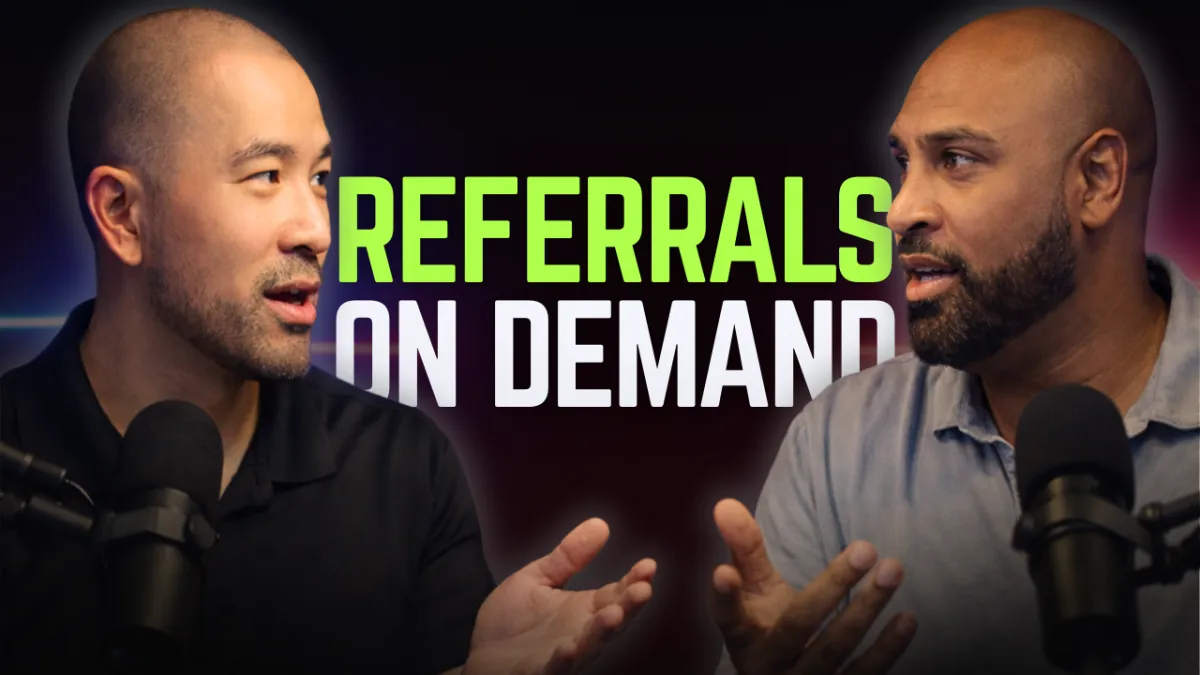
Ex-Microsoft Exec: 98% of My Revenue Came From Referrals (Not Cold Calls)
Stephen Oommen made over 1 million cold calls.
200,000 of them were manual. The old curly cord phone. Headset. Dialing one by one.
He's led nine-figure businesses at Microsoft, Outreach, and Accenture.
But here's the kicker: 98% of his revenue came from warm referrals.
Not cold calls. Not cold emails. Not automation.
Warm referrals.
Stephen joined me on The Revenue Vault to break down exactly how he systemizes referrals on demand... and why most teams leave this pipeline sitting on the table.
The question that exposes the gap
Stephen asks every CRO and sales VP the same question:
"Walk me through the last time you answered a cold call or cold email from someone you didn't know, like, or trust... gave them the meeting... and bought something of substantial enterprise value."
The awkward silence is always hilarious.
Most can think of maybe one example in the past couple years.
So here's the follow-up: if cold outbound has such a low success rate, why do you think doing more of it is the answer?
Why aren't you scaling and operationalizing the very thing you just said is how you actually buy?
Light bulb moment every time.
The system: referrals across 1,000 employees (not just 100 reps)
Most CROs think referrals = sales reps asking their network.
Stephen flips that.
He asks: why are you only looking at your 100 reps? How many employees do you have in the company?
If you had 1,000 employees, do you think your AP clerk... your director of sustainability... anyone in the company might have a cousin, friend, or connection that's a prospect in an account you're trying to get into?
Probably.
So create a company-wide culture where everyone wants to see the company win.
Here's the play:
Figure out your cost to generate a lead. Let's say $5,000.
If someone walks you into an account and it becomes a qualified opportunity, pay them $1,000.
We pay referral bonuses to recruit employees. Why not pay them to recruit revenue?
Even if only 25% of your employees do this, that's borderline free leads you wouldn't have had with just your 100 sellers.
The magic question that reveals hidden connections
Stephen runs a workshop exercise with sales teams.
He asks one magic question. Everyone writes down one name.
Every single time, the names that pop up are insane.
Owner of the New York Jets. CEOs of PepsiCo. VPs at Abercrombie. Random Fortune 500 execs.
Then he asks: "Is that company in your CRM?"
Yes, it is.
So there's a seller trying to sell into that company right now... and someone on the team knows the decision-maker intimately.
People downplay the strength of their network.
Stephen has them map their entire network by the same attributes they use for territories: industries, companies, functions, personas, roles, titles.
Within two weeks, they generate qualified pipeline in places they never thought they'd get into.
The Chameleon Effect: from defense mechanism to superpower
Stephen grew up as the child of immigrants in Oklahoma.
He got picked on for every racial slur imaginable. People didn't know what race he was.
He spent years trying to fit in anywhere he could. Defense mechanism.
But years later, he realized: the ability to adapt and show up in other people's world like a chameleon wasn't a weakness.
It was a superpower.
Now he does it proactively instead of reactively. It's a choice to show up for you.
That's the core of warm outbound: step into someone else's world, be curious, understand everything they're about.
If you want to be interesting, be interested.
You can't be all things to all people. But you can be something for everyone.
Stephen's writing a book called The Referral Effect (coming August 2026).
The core thesis: while you can't be all things to all people, you can absolutely be something for everyone.
Most people build territories around geographies and industries.
Stephen builds them around networks.
Because warm relationships beat cold activity every single time.
98% of his revenue proves it.