


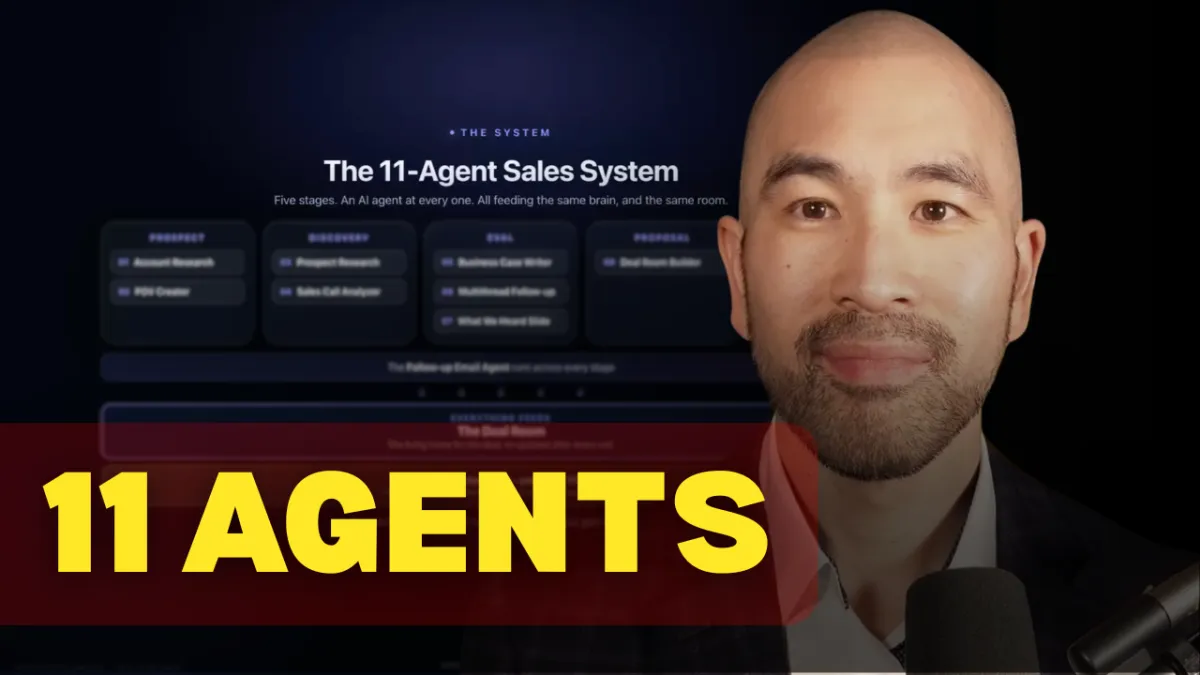
The AI System Behind a Modern Sales Team
TL;DR: Most sales teams use AI like a fancy Google. One question, one paragraph, and the number never moves. My team built 11 AI agents that run across all five stages of a six-figure deal, live, on real pipeline. Here is the part nobody selling you AI will admit. On its own, even a great agent gets you to about 85 out of 100. The last 15 points, the ones that win the deal, come from a human who knows sales. This is how the system works, and where the human still has to drive.
Your team is already using AI. That is not the problem.
The problem is how they are using it. Someone opens a chat window, types "research this account," gets a tidy paragraph, and closes the tab. It feels productive. It moves nothing. The paragraph was generic because the prompt was generic, and the rep walks into the call sounding like every other vendor who did a 90-second LinkedIn scroll.
That is AI as a fancy Google. A toy.
What I am going to show you is the opposite. A connected system, where each agent feeds the next and nothing resets between stages. The account research becomes the outreach. The call becomes the follow-up. The follow-up becomes the deal room. The deal builds on itself, call to call, instead of starting from zero every time a rep opens a blank chat.
My team spent the last year building these agents on our own pipeline. Here is what we learned.
Why does AI give most sales teams garbage?
Three mistakes. Fix these and the tools start earning their keep. Skip them and no agent will save you.
Mistake #1: they treat AI like a fancy Google. Thin prompt in, thin paragraph out. A real agent has to be loaded with context to be any good. The prompt behind our account research agent is over 20,000 characters. It is a deep-research protocol: company profile, revenue model, thought leadership on the public record, trigger events, the org chart, the economic buyer, the pain they lose sleep over. That is the difference between a paragraph and a research analyst.
Mistake #2: they do not know what good looks like, so they take the first output. The first output is never the best one. Picture a $150 steak next to a $19 steak from a quick-service spot. Most people cannot tell them apart. A chef sees the cut, the marbling, the seasoning, the cook. Same with an AI output. To most people the first answer looks done. Someone who knows sales at a high level sees the ten things that make it an 85, and knows how to push it to a 95.
Mistake #3: they treat it like it is always right. They take the answer as gospel. You have to challenge it. Question it. Make it earn the answer. The machine is confident even when it is wrong, and confidence is not accuracy.
Those three mistakes are why AI produces garbage for most teams and gold for a few. Now here is the system.
What are the 11 AI agents, stage by stage?
A six-figure deal moves through five stages. We run at least one agent at every one.
Stage 1: Prospect
Two agents. The Account Research Agent researches accounts in our target market, filters them, cuts the ones not worth pursuing, and builds an 11-section brief on each fit in about a minute. Then it hands us a list. Here is the step that matters most: we do not blast it. We read it, cut the misses, approve the fits. Only then does it load into our outreach tool or go into direct outreach to book the meeting. The POV Creator writes the one-page point of view that earns the first call.
The human part: the agent found and filtered. A human who knows the ideal customer decides who is actually worth the outreach. Most teams skip that gate and spray. That is why their outreach dies.
Stage 2: Discovery
This is where six-figure deals are won, and discovery is rarely one call. It can be three, five, ten. The Prospect Research Agent goes deeper than the account brief and preps the exact questions for this buyer at this stage. After the call, the Sales Call Analyzer scores the transcript against POWERFUL, the discovery method from my book, and shows exactly where the deal leaked and what to dig into next time.
The human part: the score starts the conversation. A human ends it. The agent flags the gap. A coach who has run real deals knows how to close it.
Stage 3: Eval
Three agents keep momentum alive when the rep is not in the room. The Business Case Writer arms your champion with a document in their own voice, so they sell it upstairs without you. The Multithread Follow-up brings the executive in without going around the champion. The What We Heard Slide turns the discovery call into one undeniable page for their leadership to open the next meeting.
The human part: the agents draft the argument. A seller who understands the politics knows who to send it to, how to tweak, and when.
Stage 4: Proposal
A proposal sent as a PDF gets forwarded to people who never heard the pitch, and they decide your fate in a thread you will never see. So we stopped sending PDFs. The Deal Room Builder turns the deal into one shared workspace: the recap, the business case, the next steps, the case studies, one link. Every stakeholder walks the same story in the same order.
Here is the part that changes the game. The room is alive. Every time we have another call, we drop the transcript in, and the agents re-update the business case and re-update the room. Always current, one place. The deal stops living in a rep's inbox. The room becomes the single source of truth, and it gets sharper every call.
Running underneath all of it, the Follow-up Email Agent works at every stage. It reads each call, matches the recap to the stage and the urgency, quantifies the impact, and threads the right message to the right stakeholder the same day.
The human part: the agent builds and updates the room. A rep who read the deal knows what belongs at the top and who needs to see it.
Stage 5: Close
Every rep has a graveyard of dead deals. Budget freeze. Reorg. "Call us in Q3." That is a pause, not a loss. The Deal Revival Agent takes a stalled deal, builds a piece of genuine value, and reopens the door. A rubric their team can use today. An audit. An industry insight report. Something that helps them whether or not they ever buy from you, which is exactly what positions you as a trusted advisor instead of another rep chasing a close.
And a bonus beyond the 11: an agent that writes the ghosting prospect a custom, funny, personalized song to break the silence. Clever, personal, and it gets replies.
The human part: the agent writes the re-engagement. A human who knows why the deal really stalled knows whether it is worth reviving, and which door to reopen.
What is the 11th agent, and why does it matter most?
One agent sits under all the others. The Master Brain. It holds our frameworks, our voice, the entire methodology, and every other agent pulls from it. It is over 60,000 characters. That is why the brief, the follow-up, and the champion doc all read like the same elite seller wrote them.
It is the part you cannot buy off a shelf, because the brain is only as good as the seller who trained it. The agents are the easy part. Anyone can copy a prompt. The standard for what good looks like, and the judgment to push an output from 85 to 95, is the actual work. Put agents on a weak foundation and you poured jet fuel into a bicycle. Put them on a real one and it flies.
Where should you start?
You do not need 11 agents. You need one, and someone who knows what good looks like to run it. Pick the stage where your best deals leak the most, and build there first.
AI will not replace your sales team. A sales team that knows how to run AI will replace the one that does not. The agents never sleep and get sharper every month. They just cannot tell when they are wrong. That part is on you.
FAQ
Can AI close a complex 6-7 figure B2B sales deal on its own?
No. An agent gets you to about 85 out of 100: fast, consistent, tireless research and drafting. The last 15 points that win a six-figure deal come from a human who knows sales, knows the buyer's politics, and knows what good looks like.
What is the biggest mistake sales teams make with AI?
Treating it like a fancy Google. They type a thin prompt, get a thin paragraph, and move on. Real agents need heavy context to produce useful work. Our research agent's prompt runs over 20,000 characters.
Do I need a specific AI tool to build a sales system like this?
No. We run ours in Claude with projects and skills, but the same principles work in ChatGPT, Gemini, or Copilot with a few tweaks. Watch the principles, not the buttons.
What is a deal room and why use one instead of a PDF?
A deal room is one shared workspace holding the recap, business case, next steps, and case studies behind a single link. Unlike a PDF, it stays current: drop in each new call transcript and the agents re-update it, so every stakeholder sees the same up-to-date story.
Want our help with deploying the right AI sales system in your org? Book a call below.