

How to Build a Sales Team That Closes Without You
Executive Summary: Bart Fanelli helped scale Splunk from $60 million to over $1 billion. He ran organizations of 275 people. He co-wrote The Success Cadence. Then he walked away from the titles and the equity to build Skillibrium. His argument is simple. Most founders try to fix sales by hiring better people. The fix is a repeatable system that anyone coachable can run. Here is the playbook.
Every founder-led company hits the same wall. You built the thing. You sold the thing. Now you have a few reps and the number still lands on your desk. So you hire your way out. A strong resume, a big title, a track record somewhere else.
Bart has watched that movie from both seats. On The Revenue Vault he walked through what he builds instead.
Why does sales keep running through the founder?
Bart's answer starts with ego. "I'm not that good," he told me. That is not modesty. It is a design decision.
He put himself in a box early. You cannot do it alone. You will get it wrong. So you need counsel feeding back to you constantly. He brought in the same people who had pattern matched the system with him over his career.
Then he named the trap. "You can't super rep it." The moment you take the deal back, you teach the team that you are the closer of record. Bart runs the opposite loop. You coach them. They execute. You debrief and adjust. You repeat.
"Before you know it, after you do that a handful of times with everybody, you have a unit that can do it without you."
We see the same thing at Venli. One HR tech client moved their win rate 47% and their deal velocity 65% in a quarter. Same reps. Different system.
What does an operating cadence actually look like?
Bart calls it the operating cadence, and it is the single system he credits most.
It answers one question. What happens weekly, monthly, and quarterly that is non-negotiable and actually advances the business? Every meeting has a structure. Every meeting has a script. Every call ends with a next best action assigned.
"If the language, if the patterns, if all of the meetings we have, if they have the right structure, the right script, and the right cadence, then by default we're advancing the business."
The part most founders skip is how he built it. He built it with the team, not for them. Everyone contributed. Everyone's input had to be genuinely considered. That is what makes people own it.
Then he inverted the accountability. "Here's the cadence, you hold me accountable, I'll feed you back, and we'll keep going."
The hard part comes later. Every new hire has to be brought into the same process. "You can't skip that part."
Why will you never outrun a bad sales plan?
Most leaders name marketing as their most important partnership. Bart learned at Splunk that the relationship that decides your year is finance.
"If you get a bad sales plan, it doesn't matter how aligned you are with marketing. You will never outrun a bad plan."
Bad capacity. Bad quota assignment. Bad productivity model. Get those wrong and the best team on earth still misses. He has argued this with executives for years and has not moved off it.
He goes further on titles. A CRO or VP of Sales without the agency to build the plan is a setup for failure. "You give someone the title, they have to have the agency to build the program that makes the title real."
If you are a founder, that is your job to hand over on purpose. Or to keep on purpose. Just do not pretend you handed it over.
Do you really need A-players in every seat?
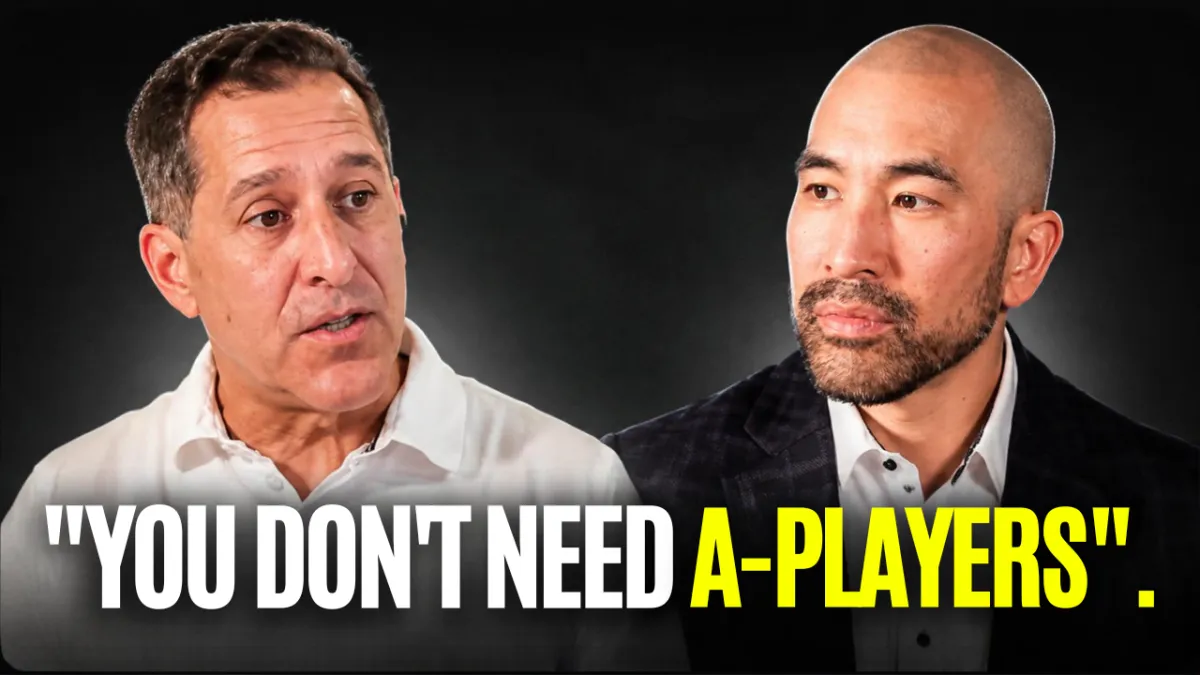
No. This is the line that will get argued with, and it is the most useful thing in the episode.
"You don't need the unequivocal A player everywhere because there's a system that's repeatable. Most people, high will, when they join, they're coachable. Show them the system, hold them accountable."
Bart screens on two axes. Skill, rated objectively by role. Will, meaning coachability and drive. He runs it as a four box, quarterly, with the leader and the rep both rating.
The payoff is defensibility. If someone deviates from the standard and will not recover, you have a documented basis to move them out. No guessing. No politics.
The cost of skipping it is the opposite. "Companies want great performance. They don't want the discipline and the boringness that comes along with it."
What does one bad sales hire actually cost?
Run Bart's math. A rep produces $200K against a million dollar quota. Fully burdened cost across the year runs into the millions. Meanwhile the territory went to a competitor who structured theirs properly from the start.
At the leadership level it is worse. A head of sales hired only to chase a number gets 14 to 17 months. "Company's left right where they started. They're probably in worse shape actually."
Then the line that should stop every founder cold. "You can't buy that time back."
Put a number on it. On a 15-person team, the gap between a 21% win rate and a 35% win rate is $2.1 million. That is roughly $150K for every point of win rate. One bad year of hiring buys you nothing and costs you both.
How do you win deals without selling?
Bart and I landed in the same place here, from different directions.
His version: "The de facto standard is people show up when they want something." Presence is the entry fee. Being useful is the edge.
The tactical move he gave is the one worth stealing. Write your contact a forward-ready communication. A short message they can send up to an executive without you in the room. You take what you learned in the technical meetings, turn it into something their boss will read, and hand it over.
"Stop trying to sell something. That will just organically happen."
He also has no patience for stale pipeline. "A lead, if it's not called within two hours, is not a lead." Seventy thousand names in the top of the funnel is not pipeline. It is a dashboard that is green on the marketing side and red on the sales side.
Where does AI actually fit?
Bart is bullish on the capability and blunt about the limit. "AI is amazing, but you can't use it as a shortcut."
His reasoning is about belief, not technology. If you did not iterate your playbook yourself and prove it works, you will not believe it. And the moment you stop believing it, you divert from it. Then you are back at square one.
There is a second limit. A human still executes. "If the human isn't rehearsed, if the human doesn't understand the system you're running, then that AI is not going to matter."
Use AI to accelerate a system you already own. Do not use it to author one you have never run.
The bottom line
Bart's whole model fits in one sentence. Build the standard, teach the standard, hold the standard, and be boring about it.
That is the unglamorous truth about sales teams that run without the founder. They are not held together by talent. They are held together by a cadence nobody skips.
If every real deal in your business still runs through you, that is the ceiling on your growth. It is also fixable, and faster than most founders think.
FAQ
Who is Bart Fanelli? Bart Fanelli is the founder and CEO of Skillibrium, a performance operating model for revenue teams. He spent seven years at Splunk during its run from $60M to over $1B, led organizations of 275+ at BMC Software and OutSystems, and co-wrote The Success Cadence with Tom Schodorf and David Mattson.
What is an operating cadence in sales? It is the set of weekly, monthly, and quarterly meetings that are non-negotiable, each with a defined structure, script, and a next best action assigned at the end. It is what keeps a sales team advancing without the founder in every conversation.
Do you need A-players to build a sales team? Bart says no. With a repeatable system and a documented standard, coachable people with high will produce consistently. The system carries the performance so hiring does not have to.
What does a bad sales hire cost? A rep producing $200K on a million dollar quota costs you the salary, the fully burdened cost, and the territory. At the leadership level it is 14 to 17 months and often $2M or more. On a 15-person team, every point of win rate is worth roughly $150K.
Why did Bart raise debt instead of equity? He found venture terms onerous for a company outside the Valley darling tier. Raising debt, including personal debt, kept the company whole and signaled conviction. He called it the most freeing decision he made.
Want a sales team that runs without you? Book a free Revenue Strategy Call below.