


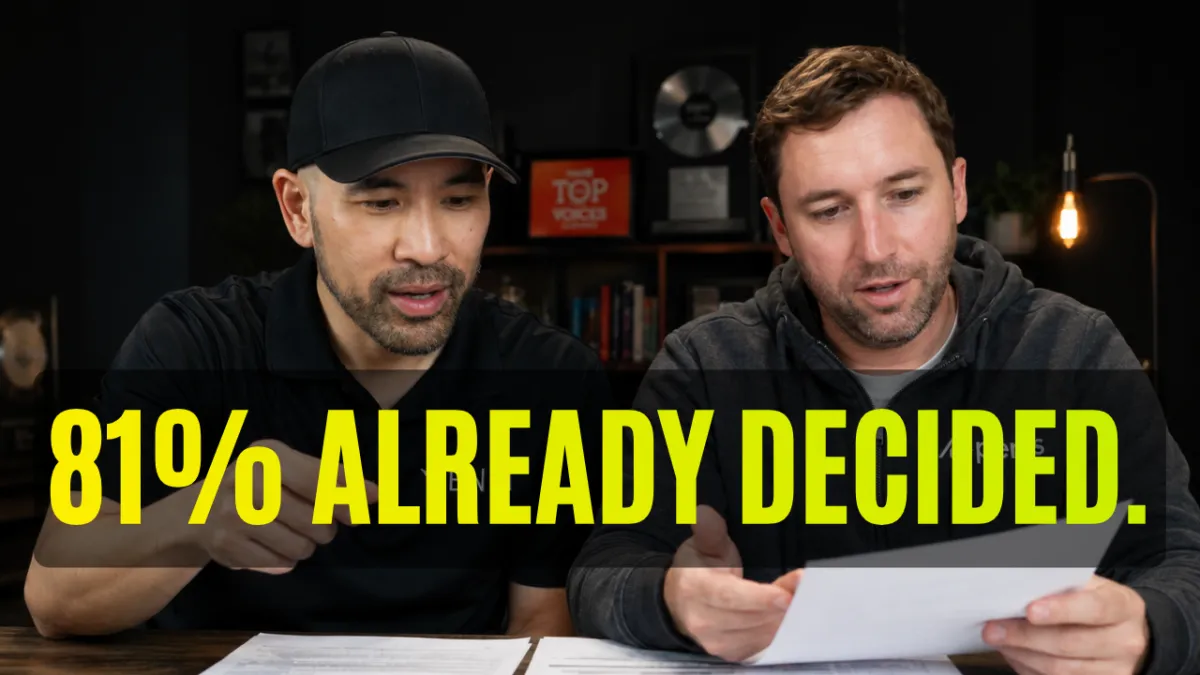
How to Fix Your Sales Forecast Accuracy: 3 Root Causes and 3 Fixes
How to Fix Your Sales Forecast Accuracy: 3 Root Causes and 3 Fixes
You forecasted $2.5M last quarter. You closed $1.9M. Industry research pegs B2B sales forecast accuracy at around 63%. Which means almost half your forecast is wrong before the quarter even starts. Across 700+ B2B sales orgs Venli Consulting has helped scale, the pattern is consistent. The issue is never effort. It is the system. Sales leaders are forecasting based on rep feelings instead of evidence. CFOs are planning around fiction. Boards are losing trust. The gap between forecast and close is not random. It is structural. And it is fixable in about 12 weeks. This is the playbook.
What is sales forecast accuracy?
Sales forecast accuracy is the percentage difference between what your sales team commits to closing and what actually closes in a given period. The B2B industry average sits around 63%. High-performing organizations operate at 80% or higher. The number is not driven by data quality. It is driven by process discipline. Three structural problems push forecast accuracy down: deals advancing without verified evidence, single-threaded deals collapsing on politics, and managers letting probability estimates float without challenge. Fix the structure and forecast accuracy follows. Industry research from Gartner, McKinsey, and Forrester all confirm the same pattern. Predictable revenue requires verifiable stage progression. Not optimism.
Why is your sales forecast always wrong?
Most missed forecasts share the same DNA. Deals get categorized based on rep gut feeling, not verifiable signal. A rep walks out of a demo and reports "the meeting went well." That phrase makes its way into a 50% probability score on the forecast. But "felt good" is not a probability. It is a hope statement. The gap between hope and evidence is where every missed forecast lives.
Look at any B2B sales org missing forecast by 20% or more. The pattern is identical. Champions get labeled based on enthusiasm rather than buying authority. Pipeline stages get advanced because reps feel ready, not because criteria were met. Managers nod along instead of pressure-testing the assumptions.
I led a 110-person sales organization generating $195M in annual TCV. Every forecast review surfaced the same recurring failure mode. Reps were not lying. They were guessing. The guesses got rolled up into board-level commitments. CFOs planned. Boards trusted. And quarters missed.
If your forecast misses by 20% or more on a recurring basis, the data is not the problem. The system that interprets the data is. Until you change the system, the forecast keeps missing.
What are the three root causes of inaccurate sales forecasts?
Three structural failures cause nearly every missed forecast.
The first is the absence of stage exit criteria. Most B2B sales orgs have stages but no defined evidence required to move between them. Deals advance based on rep enthusiasm. A real stage exit criterion is specific and verifiable. To exit Stage 2: budget confirmed, second decision-maker introduced, timeline committed. Without criteria, reps guess. With criteria, your forecast becomes evidence-based.
The second is single-threaded deals. Most pipeline runs on a single contact per account. Champion is enthusiastic. Forecast looks strong. Then the CFO objects, the champion leaves, or committee politics kill it. The deal dies. The forecast collapses. One $40M HR tech client we worked with had this exact pattern. Once they enforced multi-threading by Stage 3, deal velocity jumped 65% in a single quarter.
The third is manager hope bias. Sales managers want deals to be real, so they do not challenge probability estimates. Rep says 60%. Manager wants 60%. The forecast inherits the optimism. Without manager-led pressure testing, every Stage 3+ deal carries inflated probability. The cumulative effect is a forecast that overstates by 20% or more.
These three causes compound. Stage advancement on hope plus single-threading plus uncontested optimism produces the exact gap between $2.5M forecasted and $1.9M closed.
How do you fix sales forecast accuracy in 12 weeks?
Three specific fixes close the forecast gap.
Fix one is stage exit criteria. Write down exactly what must be true to advance a deal. Not guidelines. Specific, observable signals. Stage 2 to Stage 3 might require: champion engaged, budget confirmed, second stakeholder introduced, mutual action plan with dates. Once these are documented and enforced, deals only advance with evidence.
Fix two is mandatory multi-threading by Stage 3. Make it a hard rule. No Stage 3 deal advances without three confirmed stakeholders who have actively engaged. Not "aware of." Engaged. This single rule kills the politics-driven death spiral that wrecks single-threaded deals. We had a fintech client cut their AE ramp from 14 months to 6 months. Stage discipline and multi-threading made the difference.
Fix three is manager-validated pipeline review. Every week, the sales leader reviews every Stage 3+ deal against three questions. Does this meet stage exit criteria? Is multi-threading verified? Is there evidence, or just hope? If criteria are not met, the deal moves back a stage. The investment is 90 minutes a week. The return is forecast credibility.
If you lead a B2B sales team and want to see exactly where your forecast is leaking, book a free Executive Snapshot: https://venli.co/yt-desc-exec-pipeline
Within 12 weeks, organizations running this stack push forecast accuracy from the industry-average 63% toward 80% and higher.
What does an accurate sales forecast actually unlock?
Forecast accuracy is not just a finance metric. It is a credibility lever. CFOs stop padding. Boards stop second-guessing. Reps stop chasing dead deals. The compounding effect across a sales org is significant.
When forecast accuracy hits 80%+, the conversation shifts from defensive ("why did we miss?") to offensive ("where do we double down?"). Pipeline reviews become coaching sessions instead of interrogations. Quota planning becomes data-driven instead of speculative.
Across the 700+ B2B sales organizations Venli has helped scale, the pattern is consistent. The orgs that close the forecast gap outpace peers. Same market. Same products. Different system.
The leadership conversation also changes. CROs and VPs of Sales who hit forecast credibly tend to keep their seats longer. The opposite pattern is brutal. Forecasts that miss by 20%+ each quarter drive average CRO tenure under 18 months at high-growth B2B companies. Forecast accuracy is not optional at this level. It is survival.
Frequently Asked Questions
Q: What is a normal sales forecast accuracy?
Industry research puts B2B sales forecast accuracy around 63% on average. High-performing organizations operate at 80% or higher. If your forecast misses by 20% or more on a recurring basis, you have a structural process gap, not a data gap.
Q: How long does it take to improve forecast accuracy?
Most B2B sales orgs see meaningful gains within 12 weeks of installing stage exit criteria, multi-threading rules, and manager-validated pipeline reviews. One $40M HR tech client we worked with saw deal velocity jump 65% in a single quarter once these systems were live.
Q: What is the difference between a champion and a warm body?
A real champion has four traits. They have power to make a buying decision. They have a vested interest in your solution. They will advocate in committee meetings. They can navigate political dynamics. A warm body is just someone who likes the meeting. Most pipeline "champions" are warm bodies.
Q: Why does single-threading kill deals?
Single-threaded deals depend on one person to carry the deal across the finish line. If that person leaves, gets overruled, or loses internal political power, the deal dies. Multi-threading insulates against all three failure modes.
Q: How long does manager-validated pipeline review take?
Roughly 90 minutes per week, every week. The sales leader reviews every Stage 3+ deal against three questions. Does this meet exit criteria? Is multi-threading verified? Is there evidence or just hope? Deals that fail any test move back a stage.
Ready to fix your forecast?
If you are a sales leader and you want a custom breakdown of where your forecast is leaking, book a free Executive Snapshot here: https://venli.co/yt-desc-exec-pipeline. We will pressure-test your pipeline live and show you exactly where the gap is.
If you are a rep and want to run the diagnostic on your own deals, grab the free Playbook: https://venli.co/yt-desc-diag-pipeline.