


How Frontify's CRO Builds Elite Sellers in the Age of AI
Most sales advice about AI right now is noise. Buy this tool. Write that prompt. Automate the busywork. Ian Jentgen has a cleaner test, and it cuts through all of it.
Ian is the Chief Revenue Officer at Frontify, the brand platform behind Mercedes-Benz, Uber, and Vodafone. He came in to build the US commercial engine, hit the numbers, and earned the CRO seat from the inside. He has held it for four years in a market where most revenue leaders last about eighteen months. When someone with that track record tells you how he hires and how he thinks about AI, you take notes.
Here is what stood out from our conversation on The Revenue Vault.
His best reps can sell without mentioning the product
Ian's top 10% share one trait. They can run a full conversation about a customer's Martech stack without ever steering it back to Frontify. They talk about the buyer's world, the office of the CMO, the problems a head of brand carries around all day. The product comes up when it earns its place, and not a second sooner.
That sounds soft. It is the hardest thing to teach and the clearest signal of an enterprise seller who gets invited back into the room. Reps who lead with features get one meeting. Reps who can be a useful voice on the whole category become the first call.
The interview question that exposes everything
Ian keeps coming back to one question: "What is one thing about how we show up in market that you think we should improve tomorrow?"
It looks like a softball. It is loaded. A weak candidate gives you surface-level observations pulled off the homepage. A strong one comes with a point of view, backed by real work, about your business. Here is the part Ian watches for. If a rep can form a sharp, specific opinion about Frontify, that same muscle shows up later with customers at the executive level. The interview is a preview of the sales call.
How he tests for real AI fluency
This is where Ian gets specific, and where most teams are getting it wrong.
Frontify's final interview task is a demo plus account research: map the account, identify personas, evaluate ICP and use-case fit. In 2026, if you are not using AI for that, you are not putting your best foot forward. So Ian wants to see it. He asks candidates how they used AI to prepare, because rep AI usage and quota attainment track closely together.
He is not impressed by people who prompt well in the moment. The tell he looks for is bigger. Ask a strong candidate about their process and they do not open a chat window. They show you their system. The agents they have running. The loop that pulls trigger events every week, researches the accounts, and drops them into a sheet for review. The market updates that hit their inbox before the interview even started.
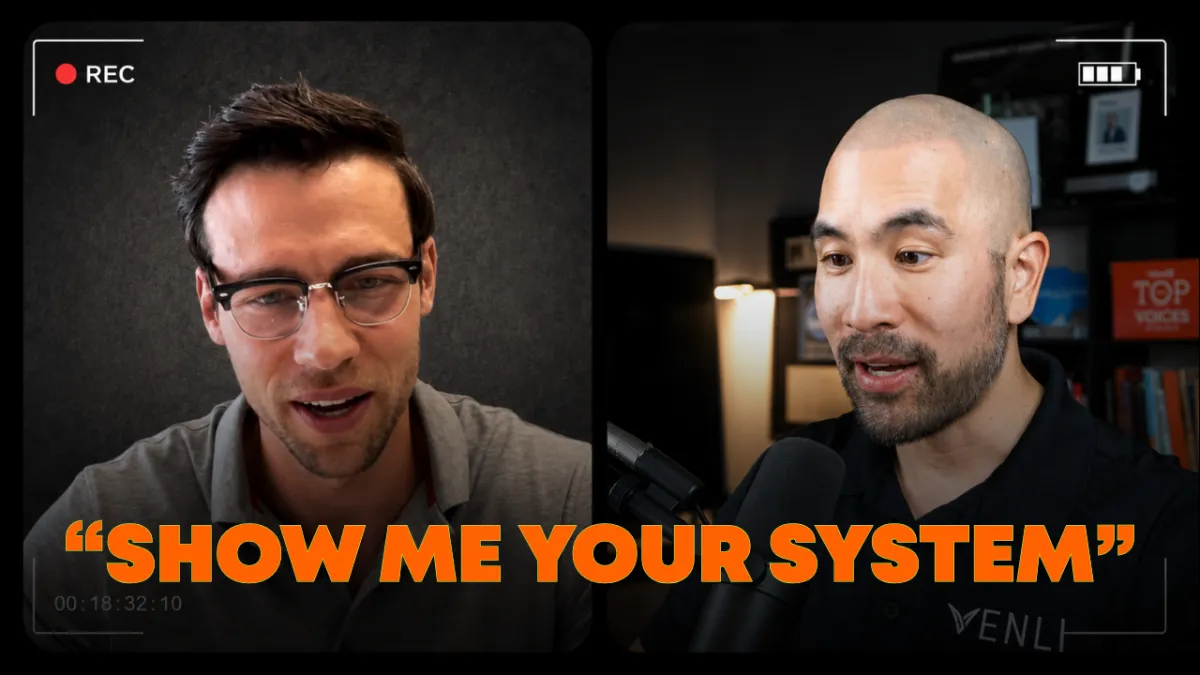
His words: show me the system, not the prompt. If you are only reliant on the prompt of the moment when you are put to the test, you are being phased out. The job now is to be the human in the loop who architects the system. The person just typing into the box is already behind.
Why he stays, and why that matters for your number
Most executives chase the next title every eighteen months. Ian has done the opposite: five years at Frontify after nearly six at his last company. Two reasons.
First, he falls in love with the domain. He stays long enough to compound what he learns about the market, the buyer, and the product. Second, the people. Staying means you watch an SDR become a first-line leader, then a second-line leader, and you get to have a hand in that. You do not see multiple promotion rounds in a twelve-month tenure. Ian's view is direct. Take care of the people part, keep leveling up your leaders, bring in A players, and the numbers generally take care of themselves. Promotion volume and attainment move together.
Competition is for losers
Ask his team and they will tell you Ian is competitive, maybe too competitive. Then he quotes Peter Thiel: competition is for losers. For Ian, the work is pace-setting and getting better every day. He sets the standard and pulls people up to it. The best leaders on his team handle the expected work, then ask what it takes to reach the next level and create cross-functional impact. He is building owners.
Lean by design
Ian runs a small enterprise team carrying a heavy load, and he is proud of it. His path to the next phase of growth runs through three things. Marketing dollars that return far more than they cost. AI adoption that stretches each rep's capacity. And a product story that matters more in the AI era than it did five years ago.
His clearest proof point: a Fortune 100 financial services firm made a seven-figure investment because they see Frontify as critical infrastructure for their AI agenda. That is the kind of evidence a lean team turns into its entire go-to-market story.
The takeaway
Brand consistency can feel like a nice-to-have until a budget crunch hits. Ian's whole approach is built to fight that, in how he hires, in how his reps show up, and in the product narrative. The thread through all of it is simple. Be the most useful voice in the room, prove it with real preparation, and build systems that compound.
If you are a CRO or VP of Sales looking at your own team and wondering where your next gain is hiding, that is the work we do at Venli. Book a free 45-minute Executive Snapshot and we will use your pipeline and call data to find the three highest-impact moves for your number.


