


MEDDPICC Scoring: How to Grade Every Deal From 0 to 16
Most sales forecasts are fiction.
The deals look real on the board. The stages look healthy. Then the quarter closes and a third of that pipeline evaporates. Nobody lied. Your reps believed their own happy ears, and you had no system to catch it.
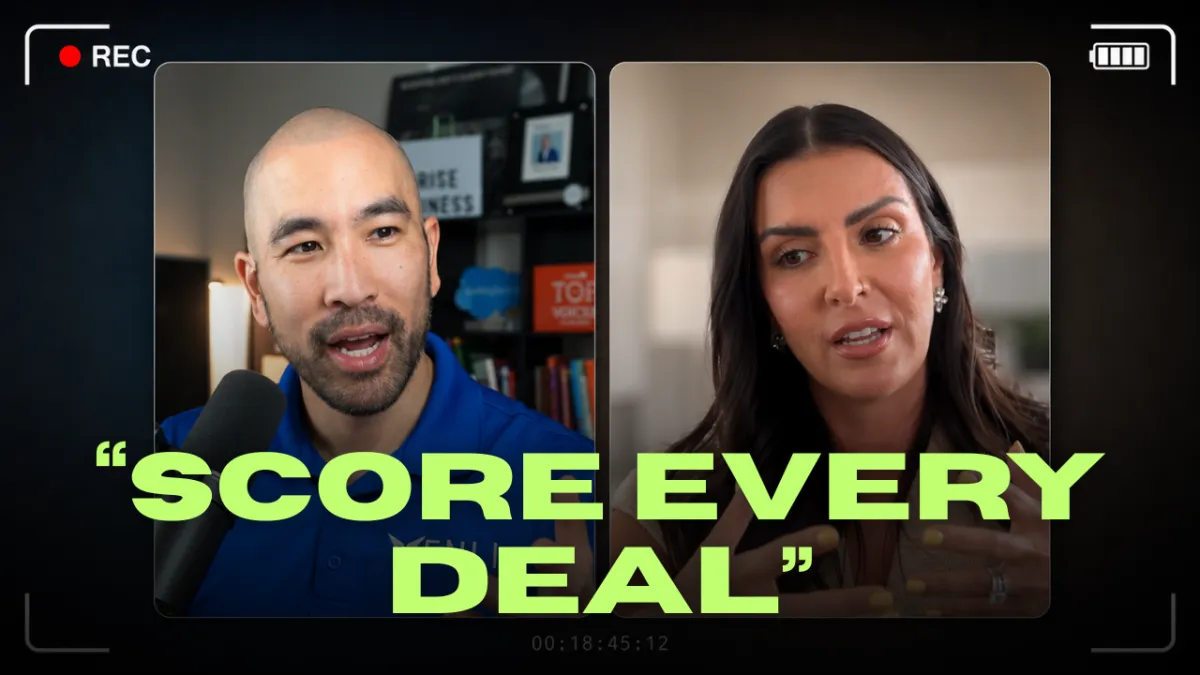
I sat down with Angela Baker, VP of Sales at Perceptyx, on The Revenue Vault. She built a brand new region where 70% of the team had under six months on the job. One year in, she posted 250% of plan and a 2,300% jump in revenue. Her CRO praised the numbers publicly, which almost never happens.
When I asked what put her org in the top 1%, she pointed to qualification and inspection. Most leaders say that. Few do what she does next.
What is MEDDPICC scoring?
MEDDPICC is a qualification checklist. Most teams treat it as a box to tick. Do we have a champion, yes or no. Do we know the economic buyer, yes or no. Binary. Useless.
Angela quantifies it. Each of the eight MEDDPICC components gets a score of zero, one, or two. Zero is the lowest. Two is the highest. The best a deal can score is 16 out of 16.
Here is why that one change matters. A binary check tells you nothing about deal health. A 12 out of 16 tells you the deal is moving and shows you the exact points still missing. As Angela put it, a 16 out of 16 is a closed deal. You have nothing left to learn about it.
How do you score each component?
The score only works if the definitions are tight. Angela writes a definition for every level next to every component, so the number is never arbitrary.
Take the economic buyer. A zero means the rep barely knows who the buyer is and has not confirmed they advocate for the deal. A one means the rep knows definitively who the buyer is and has met them once or twice, with no strong relationship. A two means the rep calls that buyer on their cell phone and the buyer answers. They are helping you win.
That scale removes the guesswork. A rep can no longer hide behind a vague "we are aligned with the buyer." The definition forces honesty.
Why champions are the most overscored
Angela named the component reps inflate the most. The champion.
A rep finds a friendly contact. The contact takes their calls and is pleasant. The rep decides that is a champion. A real champion advocates for you when you are not in the room and has the internal pull to move a deal. Nice is not advocacy.
I have reviewed hundreds of pipelines that died on this exact mistake. The rep had a friend, and the deal stalled the moment that friend hit an internal wall.
If your reps score champion a two every time they get a warm reply, your forecast is inflated and you do not know it yet.
How often should you inspect deals?
Scoring means nothing without inspection. Angela runs two forecast calls a week and treats them as a team sport.
One sits at her team level, where she is the most senior person and the conversation stays unfiltered. The second is an executive forecast call where reps speak directly to senior leaders. Salesforce is the single system of truth. If a rep updates Salesforce, she checks Salesforce before she asks them anything.
She protects one thing fiercely. The one-on-one is not a forecast call. That time is for coaching. Blend the two and you lose the only hour you have to develop the rep.
I ran a 110-rep org at a Fortune 500. The teams that hit number every quarter all shared one thing. A consistent cadence of accountability. Boring rhythm beats heroics.
Why a lower close rate can be a good sign
Angela said something most leaders will not say out loud. She does not want a sky-high close rate.
She worked at a company with a 90% close rate. The reason was simple. Reps did not log opportunities in Salesforce. The number was a vanity stat. She would rather a rep take more at-bats, lose a few, and learn from them.
Every rep still needs to know their personal close rate, for one reason: coverage. If you close 33% of what you run, you need 3x your quota in pipeline. Know the rate, know the math, build the right amount of pipeline. Guess at it and you walk into the quarter short.
The 20-70-10 coaching mistake
Here is the move that will change how you spend next week.
Angela uses a 20-70-10 breakdown. Roughly 20% of your team are top performers. 70% sit in the middle. 10% are at the bottom. Most leaders pour their time into the top 20%, because watching them close is fun. Or into the bottom 10%, because firing people feels terrible and we want to save them.
Both are a waste. The leverage is the middle 70%. Coach them up and you raise the average revenue per rep across the whole team. That average is the real number a leader owns.
What actually kills enterprise deals
When I asked Angela about her lost deals, the data was blunt. Since the start of the year, 83% of her lost opportunities did not go to a competitor. They stalled. Budgets froze. Priorities shifted. The buyer went quiet.
Stalled is harder to beat than a competitor. You can out-sell a rival. You cannot out-sell indifference with a better feature sheet.
Three moves cut stall rates more than anything else I see work across client orgs. Multi-thread every deal from the first call, so one quiet contact cannot freeze it. Co-build the business case with the buyer after call one, so the value belongs to them. Lock the economic buyer early, so you are tied to a real priority.
I had a $40M HR tech client stuck at a 22% win rate. We installed this kind of rigor. One quarter later they were at 47%, and their deal velocity jumped 65%. The framework did that.
The leader takeaway
Qualification and inspection are not glamorous. That is exactly why most orgs run the box-ticking version every quarter. Angela runs the hard version, and the results show it.
If your forecast keeps surprising you, the leak is almost always here. Deals scored on feelings. Champions who are only friendly. A cadence that slips the moment the calendar gets busy.
You can find where your own pipeline is leaking. Book a free 45-minute Executive Snapshot and we will use your real pipeline and call data to pinpoint the three moves that grow revenue fastest. Book it below.
FAQ
What does MEDDPICC stand for?
MEDDPICC stands for Metrics, Economic buyer, Decision criteria, Decision process, Paper process, Identify pain, Champion, and Competition. It is a qualification framework for complex B2B deals.
How do you score a deal with MEDDPICC?
Score each of the eight components zero, one, or two, with a written definition for each level. Add them up. The maximum is 16. A higher score means a healthier, better-qualified deal.
What is a good MEDDPICC score?
A 16 out of 16 means the deal is effectively closed, with nothing left to learn. Most healthy active deals sit around 12. The gap between the score and 16 shows the rep what to work on next.
Why do reps overscore the champion?
Reps confuse a friendly contact with a champion. A real champion advocates for you when you are not in the room and has internal influence. Test for influence before you score it a two.
How often should sales leaders inspect pipeline?
Run forecast or deal-review calls at least weekly, and keep them separate from coaching one-on-ones. A consistent weekly cadence catches stalled deals before the quarter ends.


