
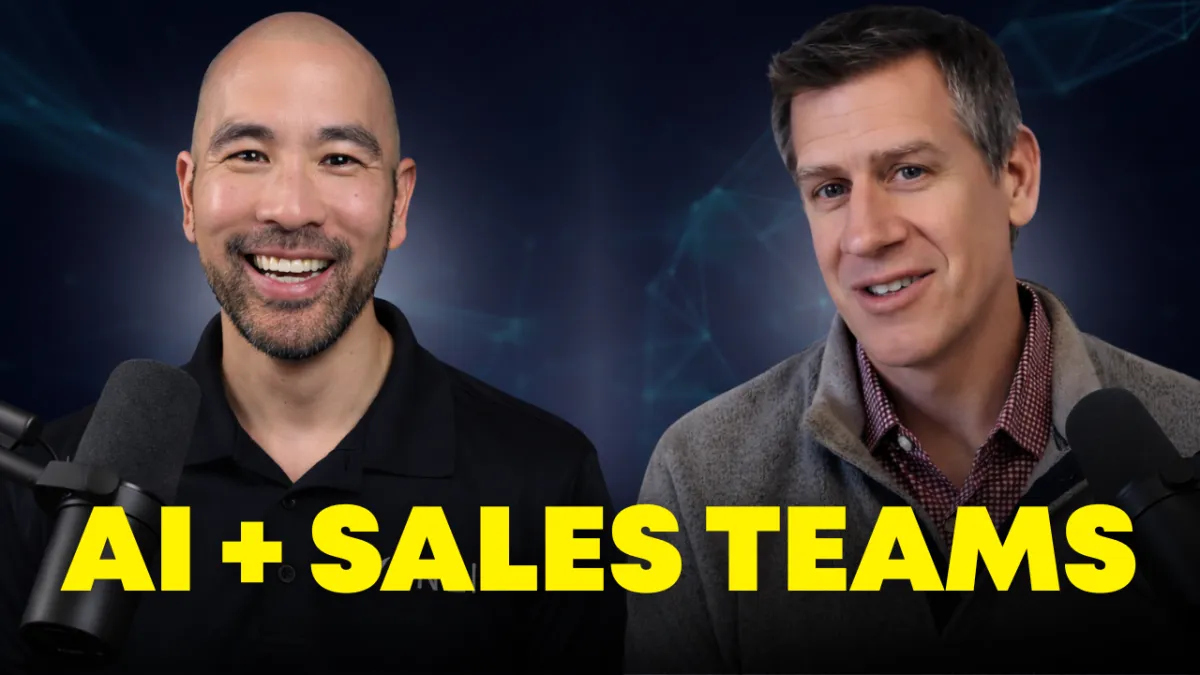
How AI Will Separate Winning Sales Teams from Everyone Else (CEO of Teret AI, Former Oracle Sales Exec)
I just sat down with Justin Shriber (CEO of Teret AI, former CRO at Oracle) and he broke down exactly why most sales leaders are setting themselves up to fail with AI, and what the winners are doing differently.
Here's the thing.
CROs are taking massive swings on complex problems. And they're crashing.
Justin told me the biggest mistake he sees: leaders trying to solve their gnarliest sales challenges with AI right out of the gate. Complex forecasting. Multi-threaded deal execution. Enterprise-level pipeline management.
These projects fail. Hard.
Why? Because there are learnings that come from small wins. The CROs crushing it right now? They start small. Compartmentalized problems. Nail it. Learn. Add momentum.
"First of all, they get success. They show that to other people, get them on the bandwagon, get more resources. And with the learnings they've gathered, they de-risk the bigger projects."
Start with data hygiene. It's unsexy. It works.
The right first move? Fix your data.
Everyone knows CRM data is unreliable. Subjective. Incomplete. And AI lives on context: garbage in, garbage out.
Small win example: Automate CRM updates. Right now, reps update systems the night before deal reviews, trying to remember what happened, second-guessing what the boss wants to hear.
AI agents can sit on calls, scan your inbox, pull from revenue-facing systems, and auto-populate CRM with objective data. Clean. Complete. Accurate.
That's a foundation. Not flashy. But it unlocks everything else.
Top performers will be disproportionately advantaged. Mediocre reps won't keep up.
Justin's theory: AI is a power tool.
"I'm a big woodworker. When you put a power tool in somebody's hand who doesn't know how to build, they're gonna do a lousy job. They're just gonna do it faster. But if you have a skilled craftsman and you give them a power tool, suddenly they're gonna double or triple the amount of great work they can do."
AI amplifies inherent skillset. If you're average, you'll stay average—just faster. If you're elite, you'll become unstoppable.
Sales teams will be smaller. More skilled. If you're not exceptional, you probably shouldn't be in sales.
The three buckets of AI adoption (and who survives):
Bucket 1: Curious people already using it, experimenting, pushing limits
Bucket 2: Waiting to be told how to use it
Bucket 3: Resisting ("It's overblown, it'll pass")
Justin's take? Bucket 3 shouldn't be in your org. Bucket 2 is on the bubble. Bucket 1 wins.
"The thing about AI is that it's really self-initiated. People that are curious, motivated to figure things out on their own—those are the hallmarks of who's successful."
What to ask before buying AI (don't get burned):
Justin gave me the framework for evaluating AI vendors:
1. Data access: Can it access user-based systems (inbox, calendar, Zoom) while respecting permissions?
2. Ontology: Does it understand YOUR vocabulary? (EMEA means different things at different companies)
3. Inference: Can it connect data that's not explicitly tagged? (Email says "Let's do it" → AI infers which deal)
If a vendor can't answer these three, walk away.
The future: Smaller teams, higher standards, agent-to-agent deals.
In 3-5 years, sales teams will be leaner. More skilled. Margins will expand because automation replaces low-skill functions.
Transactional sales? Gone. Inside sales? Diminished. High-touch, strategic deals? Still human but with fewer people doing the work.
And eventually? Agent-to-agent transactions. Your AI negotiating with their AI.
Wild. But coming faster than you think.
Wrapping up
AI isn't the future. It's now.
Start small. Fix data hygiene. Use it like a super assistant, not a replacement for thinking.
The reps who master this will double their output. The ones who resist will be left behind.
Your move.



Mail
Facebook
LinkedIn
X
Pinterest
Snapchat
Reddit