
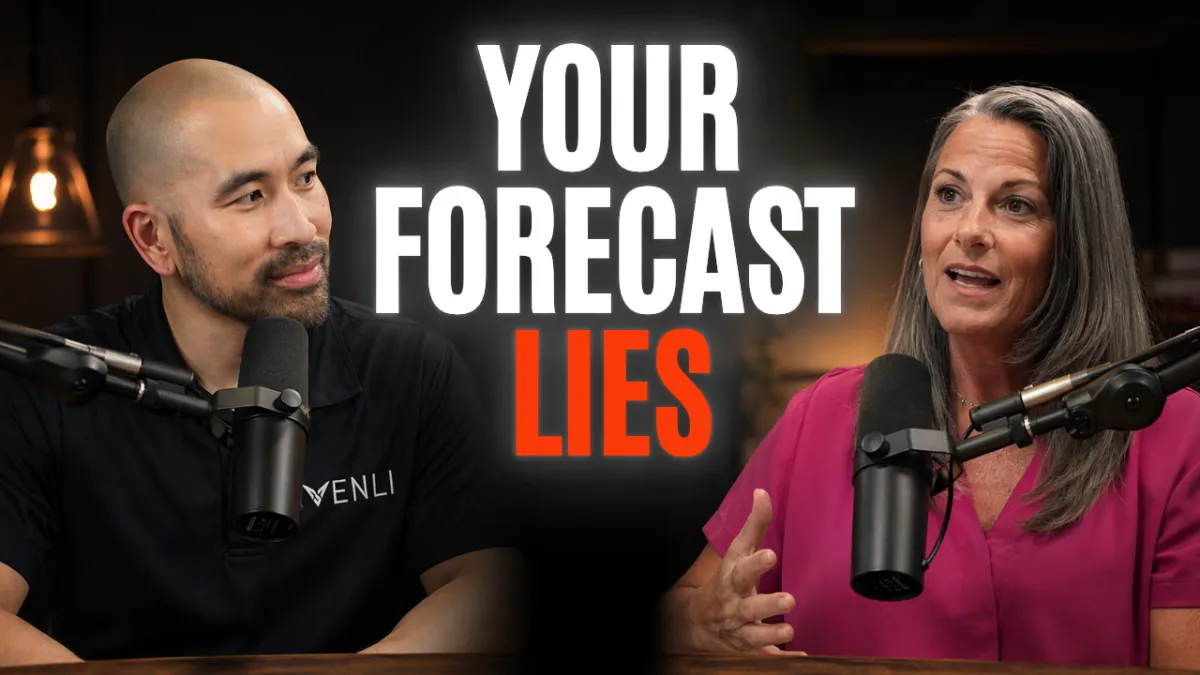
Why This 9 Figure VP Told Her CRO The Forecast Was About To Get Ugly
It is the last Thursday of the month.
The CRO is in a conference room staring at a number that was supposed to be $4.2M. It is sitting at $1.1M. The board call is in six days.
He pulls up the Monday commit from four weeks ago. Every deal that was supposed to close is still in the pipeline. Not one of them died. They just slid. Again. Like they slid last month. And the month before that.
He already knows what the reps are going to say on Friday's forecast call. "It's definitely going to close next month." He has heard it 40 times this year. This is not a rep problem. It is not a discipline problem. It is not a market problem. It is that no one in the building has ever written down what a "committed" deal actually is.
I have audited over 100 sales organizations. In 80% of them, the forecast is fiction, and the leaders smoking the hopium pipe with their reps do not realize they are holding the same pipe. Reps put deals in commit because the prospect said "probably" three weeks ago. Managers roll it up because challenging it feels like calling the rep a liar. The CRO scrapes 20% off the top, prays, and repeats the cycle every 30 days.
Kerry Grueneich walked into exactly this pattern when she took over enterprise sales at Conterra Networks, a $103M fiber infrastructure operator with four distinct sales motions under one org chart. She fixed it in 90 days. She did not roll out a new CRM. She did not hire a forecasting consultant. She wrote down the 10 boxes a deal had to check before any rep was allowed to call it committed, and then she enforced it.
Her CRO saw the ugliest beginning-of-month commit number he had seen in a year.
Then, for the first time in a long time, the month actually landed.
Below, I have broken out the core frameworks so you can put them to work this week.
What Is Sales Forecast Accuracy?
Sales forecast accuracy is the measurable gap between what your team commits at the start of a period and what they actually close by the end of it. At a functional level, it is a reflection of two things: the quality of the standard your reps are qualifying against, and the discipline of the managers enforcing that standard.
Most teams skip this distinction entirely and then wonder why their board meeting feels like a crime scene.
The Root Cause: Nobody Defined What "Committed" Means
Kerry's first move was not a dashboard. It was not a new CRM field. It was a definition.
She ran the forecast data through an AI model and saw the same deals sitting in commit month after month, pushing out by 30 days every cycle. When she asked the reps how those deals earned the right to be in commit, the answers were all over the map. Some reps had a verbal. Some had a meeting scheduled. Some just had a gut feeling.
The fix was a 10-checkbox standard. Every deal in commit had to clear all 10 before it could be categorized that way. Kerry warned her CRO that the commit was going to look ugly for the first 30 days. It did. Then it became real, and the rest of the year's forecast actually landed within range.
The 4-Week Onboarding System That Cuts Ramp Risk
Before Kerry arrived, Conterra had no formal onboarding. Frontline managers trained reps however they felt like, and first-year churn ran high. She built a 4-week program with three non-negotiables:
1. Reps produce while they learn. By the end of week 4, every new hire walks out with a target list, booked appointments, and their power statements (Mike Weinberg's framework).
2. Sales directors own the handoff. New hires present a 30-60-90 plan to their director and the enablement team at graduation. Then they are tracked against those benchmarks for a full 12 months.
3. Leadership stays in the loop. Kerry personally attends every 30-day check-in. She is not micromanaging. She is identifying non-tenured rep risk before it becomes churn.
One fintech client I worked with cut AE ramp from 14 months to 6 months using a similar system. First-year retention doubled. The reps did not change. The system did.
If any of those root causes sound familiar, here is the fastest way to find out which one is costing you the most.
The Leadership Charter and Ecosystem Call
Most sales leaders I work with have a revenue target and a prayer. Kerry runs a leadership charter.
Every year, she pulls her sales directors into a group goal-setting session. They build the tactical growth levers together. Each director becomes the champion of one section of the charter. Then they report back every two weeks in what Kerry calls an "ecosystem call" with product, marketing, enablement, and engineering planning all in the room.
Buy-in is not a poster on the wall. It is a weekly operating rhythm.
The 75% of the managers I work with who were promoted without a system for developing their team? They are not bad managers. They are unsupported ones. A charter and a cadence fix that faster than any coaching program.
Using AI to Surface Pipeline Risk
Kerry is not a data analyst. She was handed 500 spreadsheets and told to make sense of them.
She ran the data through AI models instead. What she learned in hours would have taken her weeks to find manually: the forecast inaccuracy trend, the leading indicators of churn in non-tenured reps, and the 6-month-out risk signals that let her reposition strategy before the quarter cratered.
This is the difference between managing from a rearview mirror and managing from the windshield.
FAQ
How do I improve sales forecast accuracy?
Start by writing down what a committed deal is. Most teams do not have a written standard. Kerry Grueneich at Conterra built a 10-checkbox definition, trained her reps and managers on it, and enforced it. Her forecast became real within 30 days. The fix is not a new tool. It is a standard.
Why do sales reps put deals in commit that should not be there?
Because no one has given them clarity on what earns a deal the right to be there. When reps rely on gut feeling instead of a written standard, commit becomes a proxy for hope. Leaders then scrape 20% off the top and call it forecasting. That is not a forecast. That is a feeling.
How long should onboarding take for a new B2B sales rep?
4 weeks of structured onboarding followed by 12 months of tracked benchmarks. Reps should produce pipeline during training, not after. A fintech client of ours cut AE ramp from 14 months to 6 months using this model and doubled first-year retention.
What is the biggest risk to a growing sales organization?
Churn. When first-year rep churn runs high, your frontline managers pull attention away from your top producers to constantly onboard new hires. Your top performers get frustrated and leave. The bucket leaks from both ends, and growth stalls. Fix the system that causes churn, not the reps who churn.
How do sales leaders use AI for pipeline management?
The most valuable use is trend analysis and risk mitigation. Instead of manually sifting through spreadsheets, feed forecast, activity, and pipeline data into an AI model and ask it to surface leading indicators of risk six months out. You move from reacting to lagging data to acting on leading signals.
The Real Problem Is Not Your Reps
Your reps are not broken. Your sales system is. If your commit is soft, your ramp is slow, and your managers are drowning in onboarding instead of coaching, the problem is structural. Individual heroics do not scale. Systems do.
If you lead a CRO or VP of Sales seat at a B2B company with a 5-25 person revenue team, the Executive Snapshot is built for you. Find your top 3 revenue leaks and walk away with a 1-page memo for your CEO or board.
Book it below.



Mail
Facebook
LinkedIn
X
Pinterest
Snapchat
Reddit