
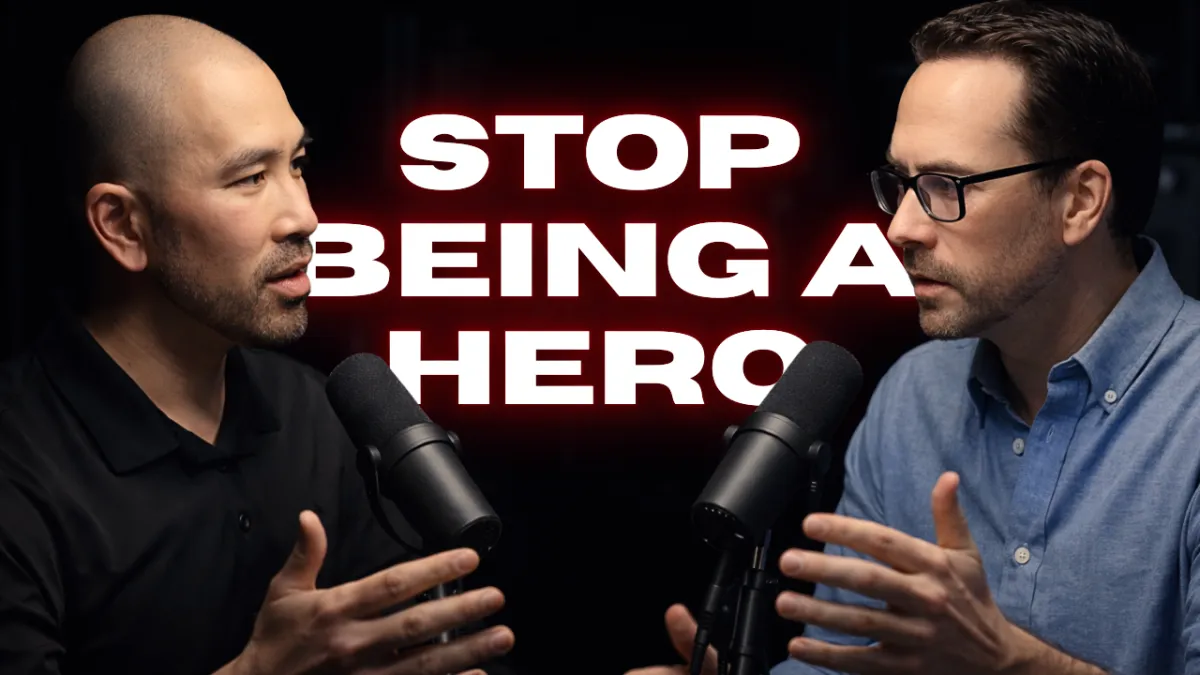
$1.5B RVP: “Operational Clarity Beats Heroics”
Most sales leaders are heroes.
They jump on deals. Solve problems. Work weekends. Save quarters.
And they burn out their teams doing it.
Thom Wright, RVP at UiPath, runs it differently.
"Operational clarity beats heroics."
Here's what that means:
Thom's teams don't work harder. They remove noise faster.
Clear operating rhythm. Shared language. Zero ambiguity.
And they hit Presidents Club year after year.
The 3 meeting operating rhythm
Most teams have forecast calls every week. Deal reviews. Pipeline calls. QBRs. Strategy sessions.
Thom has three meetings. That's it.
Meeting 1: Weekly 1:1s (1 hour, never missed)
First 10-15 minutes: forecast review (current quarter, next quarter, rolling 12-month pipe).
Rest of the hour: rep's time. Coaching. Development. Career.
No separate forecast call needed. Why?
"I talk to my AEs every day. I know those deals like the back of my hand."
Shared doc in Quip. Both add notes. Full transparency. Documentation for PIPs if needed.
Meeting 2: Team meeting (Monday, 1 hour)
Not for deal reviews. Not for forecasting.
State of the union. Updates. Enablement.
Second half: sharpening skills. Guest speakers. Book reads (The Jolt Effect on overcoming customer indecision).
Meeting 3: RAP review (15 minutes, first Friday of month)
RAP = Revenue, Accountability, Progression.
Not for strategy. Not for coaching. Not for excuses.
Just data.
R - Revenue: What did you commit and close last month? Red (below), yellow (behind), or green (exceeding).
A - Accountability: Two metrics that matter.
- Pipeline generated: $300-400K/month
- Net new meetings: 2-3 per week
Every metric has a why. Two to three meetings/week = 1 opportunity. 4 opportunities/month at $175K ASP = goal hit.
P - Progression: Did you progress 75%+ of your rolling 12-month pipe last month?
Green = 75%+. Yellow = 50-75%. Red = below 50%.
The data speaks. Dashboard in Salesforce. Can't hide.
After 2-3 months, trends emerge. "You're green on accountability but yellow on progression for two months. Let's dig in."
Psychological safety: Red-Yellow-Green
Every 1:1 starts the same way.
Not "How are you doing?"
"Red, yellow, or green?"
Green = awesome, focused, ready.
Yellow = distracted, something's off (don't have to explain).
Red = can't take it, about to break.
"I ask not to fix it. Just to know how they are."
Google's Project Aristotle found psychological safety as one of five factors for high-performing teams.
When a rep trusts you, they tell you the truth.
Building trust: vulnerability
Thom made a pricing mistake on a deal. Had to go back to the customer.
Called the rep after: "I was wrong. I messed up. This is my fault. I'm sorry."
Two-second pause.
"I've never had a sales manager apologize to me. Thank you. That meant a lot."
Your words and actions either align or they don't.
Reps talk to other reps. They know.
The trust recession
COVID era: fish jumping in the boat. Bad managers got a pass because results still came in.
Now? "The tide's going out. You see who's swimming without shorts."
Leaders who acted like jerks during easy times? Reps are quitting.
Quiet quitting. Pushing back.
"We're in a trust recession. Leaders need to act differently to get results."
How to double revenue without doubling headcount:
Efficiency beats expansion when markets tighten.
1. Tighter ICP focus (who have we won? what stories tie to that?)
2. Fewer but better deals (bigger, longer terms, more expansion room)
3. Shorter decision cycles (champions, mutual action plans, executive alignment)
4. Better qualification discipline (Why now? Why us? Why anything?)
Wrapping up
Pressure doesn't fix broken systems. It reveals them faster.
Build the operating rhythm. Create psychological safety. Remove noise.
Your team won't work harder. They'll just win more.



Mail
Facebook
LinkedIn
X
Pinterest
Snapchat
Reddit