


How to Use AI in Your Sales Process Without Killing Your Pipeline
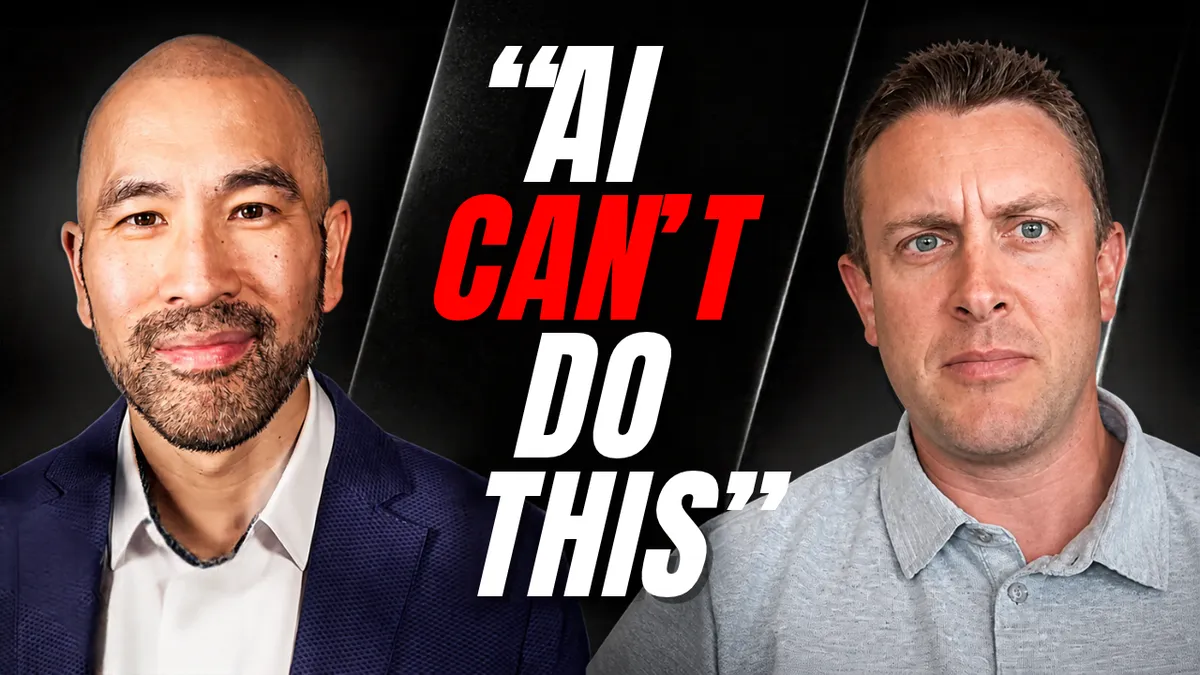
Jon Cheney builds AI systems for a living. He runs GenAIPI, sits in as a fractional Chief AI Officer for companies rolling AI out across sales, operations, and support, and he built his own company over a weekend for under $400 without knowing how to code.
So I expected him to tell me to automate more of the sales process.
He told me the opposite. Most sales teams are leaning on AI too hard, and it is costing them deals.
Here is his case, and what I would add to it after watching founder-led teams try this.
Why is outbound getting harder?
Jon put it in one observation about his own week. His LinkedIn inbox and his email are more full than they have ever been. His phone barely rings.
That is the whole problem in two sentences.
Everybody figured out the same thing at the same time. AI can send the emails, add the connections, fire the DMs, run the sequences. So everybody pointed it at outbound simultaneously, and the channel collapsed under its own volume.
I watched an earlier version of this five years ago when sequencing tools arrived. Load a thousand prospects, hit them nineteen days in a row across three platforms. That was a hundred times more volume than what came before. AI made it a hundred times that again.
Meanwhile the one channel that requires a human to actually do something went quiet. Jon's phone is not ringing because almost nobody is picking up a phone.
That is not a complaint. That is an opening.
What should sales teams actually use AI for?
Jon's split is clean, and it holds up.
Use AI for everything upstream of the human contact. Finding prospects. Researching them. Writing you a real brief before a call. Narrowing 15,000 possible targets down to the 100 that actually make sense, and explaining why those 100.
That is enormous leverage and almost nobody is doing it well.
We run a version of this at Venli. An agent works through trigger events every week, filters the list, does the research, and hands us a shortlist. We check its work, pick the ones that make sense, and load them. The machine does the finding. The judgment stays with a person.
What should you never hand to AI?
The conversation.
Jon's reasoning is that sales is inherently human because the buyer is invariably human. People want to be sold to by a person. They want another human to tell them what this actually means for them. If you are selling to AI agents, different story. Almost nobody is.
This is where teams get hurt. They automate the part that required a person, and they keep the part the machine could have done.
What does a standout play look like?
Jon told me about a company selling a B2B product at roughly $200,000 a year. Real budget per deal.
They mailed 100 CEOs a bag of Traeger grill pellets. Thirty or forty pounds of wood pellets, with a note. Meet with us and we will send you the grill.
Sixty said yes. The grills ran about $1,000 each, so roughly $60,000 in cost. They closed about 25% of those meetings. Fifteen deals at $200,000 is $3 million.
The grill is not the lesson. Here is the lesson.
It cost something, and effort is the signal. An email costs nothing and reads exactly like it cost nothing. It arrived in the physical world, where almost no competitor is showing up anymore. The ask was small. Take a meeting, keep the grill. And the real money moved only after the yes, so the expensive part was never wasted on people who said no.
I ran the same idea at a Fortune 500 with a 110-rep team. Every rep sent three physical things a week. Hot sauce with a line about getting burned by the competition. A cake that said working with us is a piece of cake. It is goofy. They remembered it every single time.
My team still does it. A black box with a few sales books and a handwritten note arrives before the first email, the first call, the first anything.
Should you use an AI SDR?
Jon says yes, with two rules.
Let it set appointments. Never let it run the sale. It books the meeting, collects the information, and hands off to a person.
And tell people it is an agent. Open with it. He scripts it as this is Jon's agent calling from GenAIPI, we are an AI company, and this is an example of what we could build for you. The disclosure becomes the demo.
The economics are hard to argue with. He put these in the range of $99 a month. An agent never gets discouraged after a no and never needs a break.
I tested this from the buyer side by accident. My dishwasher died at 7pm and I started calling repair shops. Most went to voicemail. One picked up: Bobby, an AI agent. I pushed it twice for a price it could not honestly give, and both times it held its ground, explained why a misdiagnosis would be worse, and closed me on a $95 diagnostic. When I called back to test it in front of my wife, it knew who I was and confirmed my Friday window.
The punchline came Friday morning. I called to narrow the arrival time and got a human receptionist who could not answer the question. I wanted Bobby back.
That is the bar now.
Where is the biggest AI mistake at the company level?
Jon says most organizations are not pushing hard enough on what is possible. They use ChatGPT to write slightly better emails and stop. He calls it using it like a calculator.
He still walks into companies where humans copy data from one program into another program by hand. Start there.
His prompt for anyone stuck is worth stealing. Go to whatever model you already use and ask what you would do if you wanted to genuinely push the limits at your company. Most people have never asked.
One client of his runs a staffing company as employer of record for about 5,000 employees, with a required incident hotline staffed by three people. They rebuilt it with an agent as the first line, escalating anything serious to a human. Case resolution went from 33 days to 12. The team went from three people to one, and the other two moved to HR work that had been sitting untouched. Savings landed around $120,000 a year.
How do you get a team to actually use AI well?
I tried this badly first, so learn from the second attempt.
I told my team their job was to replace themselves. Every department has a North Star KPI. Find ways to do that work without you, and no, this is not a layoff. Get your 40 hours to 10 and spend the other 30 making the company more valuable.
Nothing happened. The instruction was real and the constraint was missing.
So I ran it again with a forcing function. Take Friday. Do nothing else. Show us Monday.
That Monday they brought back ideas I did not know were possible inside their own functions. Same people, same tools, one day of protected time.
The other half is showing them how you work. A founder who says use AI while visibly treating it like a fancy Google gets a team that treats it like a fancy Google.
How do you get better output from AI?
I wrote a 20,000-word video sales letter recently. First output was a C plus. Writing it myself at the quality I wanted would have taken a month.
About fifteen hours of back and forth later it was better than what I would have written alone.
Two things made the difference.
A rating loop, which I stole from my kids' doctor. He asks them to rate pain zero to ten, which turns something vague into something workable. So I ask the model to score its own output as the best copywriter in the world would, brutally honest. It says seven. Then I ask what gets it to a ten. Run that a few times and the quality curve is visible.
Jon adds the question I was missing. Once it is good, ask whether it is now over-engineered. Ask if there is a simpler way. Sometimes it agrees and cuts. His deeper point is that pushing the model clarifies your own thinking as much as it improves the draft. You come out understanding your message better than when you started.
What has to be true before you automate anything?
This is where I go past what Jon said.
When a team automates outbound, they automate whatever they were already doing. AI has no opinion about your standard. It runs what you already had, faster and louder.
So a vague message becomes a vague message at a thousand times the volume, and the owner concludes that outbound is dead. Outbound is fine. The standard was never written down.
Run the test. Ask three of your reps to describe a good discovery call. Three different answers means you have three opinions where a standard should be.
Three things have to exist before automation helps.
Founder Grade™ is the written playbook of what good looks like at every step, built from what actually happens on live calls.
Revenue Rhythms™ is the cadence that holds the standard up, the one-on-ones and team meetings and coaching that happen whether or not the quarter is going well.
Hire Ready™ is the hiring profile, the comp structure, the hiring gauntlet, and a 90-day ramp that gets a new rep to the standard.
Get those in place. Then automate the parts that deserve it and put your people on the parts that close.
The short version
Use AI to find the 100 names inside the 15,000. Then go be a human at those 100.
And write down what good looks like before you scale anything, because volume multiplies whatever you already had.
Frequently asked questions
Should sales teams use AI?
Yes, for research, targeting, prospect briefs, and list building. Jon Cheney's position is that teams get in trouble when they hand AI the conversation itself, because the buyer is a human who wants to be sold to by a human.
Why is cold email stopping working?
Volume. AI made sending nearly free, so every inbox is saturated and prospects delete on sight. The channels that still require human effort, particularly the phone and physical mail, got quieter at the same time and now stand out more than they have in years.
Does direct mail still work in B2B sales?
It works when the deal size justifies it and the ask is small. Jon Cheney described a company that mailed 100 CEOs bags of grill pellets with an offer to send the grill in exchange for a meeting. 60 accepted, roughly $60,000 in grills, about 15 closed deals at $200,000 each.
Should I use an AI SDR?
Use it to set appointments, never to run the sale, and disclose that it is an agent at the start of the call. Jon Cheney puts entry-level options around $99 a month.
How do I get my team to actually adopt AI?
Give them a protected block of time and a deadline to present what they found. Marcus Chan gave his team one Friday with no other work and a Monday huddle to show results, after a vaguer version of the same instruction produced nothing.
What is the most common AI mistake companies make?
Using it like a calculator. Slightly better emails, nothing structural. Jon Cheney still finds companies where employees manually copy data between systems, which is the cheapest place to start.
Will AI fix my pipeline problem?
Only if a standard exists first. AI runs whatever process you already have at higher volume, so an unclear message becomes an unclear message at scale. Venli installs the standard through Founder Grade™, Revenue Rhythms™, and Hire Ready™.
Ready to get your team closing the big deals without you? Book a free Revenue Strategy Call below.