


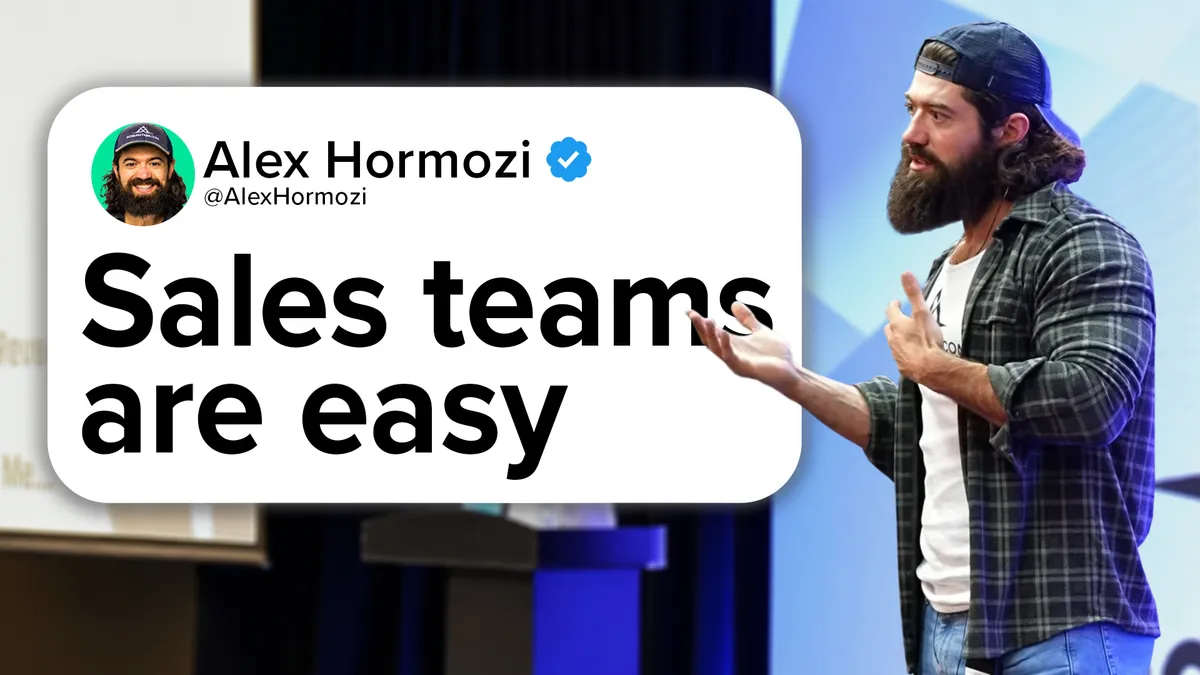
Alex Hormozi's Sales Team Advice: What He Gets Right and What Founders Miss
Body Copy:
Executive Summary: Alex Hormozi's advice on sales teams holds up: stop trying to clone the founder, write the sales process down before hiring into it, and make the offer strong enough that a trained rep can close it. Growth runs on volume, conversion and retention, and most founders over-invest in volume. The piece founders miss is the operating system: the weekly coaching, call review, scorecards and stage definitions that keep a sales process alive after the hire. Venli installs it in eight steps across four phases, starting with an honest win rate and live-deal coaching, and ending with managers running the system without the founder.
What does Alex Hormozi say about building a sales team?
Hormozi's core warning to founders is the clone trap. The founder built the revenue on their own calls, so when it's time to grow, they try to hire someone who sells like them, sit that person beside them, and hope it transfers.
His fix is to systematize first. Write down how the company wins, then hire people to run it. He pairs that with his offer-first philosophy, laid out in his book $100M Offers: make the offer strong enough that selling it gets easier.
That second idea matters more for sales teams than most founders realize. If an offer only closes when a genius is on the call, the team cannot scale, because there aren't enough geniuses to hire. A stronger offer lowers the bar for what a good rep has to be.
Why do most founder-led sales teams get built wrong?
They hire before the process exists. A founder adds a rep, a second rep, or a VP of Sales, and plans to document the process later. Later rarely arrives, because the only person who can write it down is still on every important call.
Past a couple of reps, staying in every deal stops being possible. Eight reps means eight pipelines every day. The founder becomes the bottleneck the whole company squeezes through.
How should founders think about volume, conversion and retention?
Hormozi's body of work boils down to three pillars of growth.
Volume. Enough at-bats through outbound, content and paid. Hormozi has an episode of his podcast titled "Volume Negates Luck."
Conversion. A repeatable process any trained rep can run, written down and practiced so the result holds no matter who picks up the phone.
Retention. Keeping clients longer so revenue compounds. When a business loses customers about as fast as it adds them, growth stops regardless of how many it signs.
Most founders work almost entirely on volume: more leads, more ads, more content and more reps. Conversion gets an annual training day. Retention gets attention after a large client leaves.
Why doesn't hiring more salespeople fix a missed number?
Adding headcount into a team without a system multiplies the cost of the gap.
Option | Cost | Output |
|---|---|---|
Two reps at $500K each | Two salaries, two ramps, two pipelines, two people who need the founder | $1M |
One rep at $1.4M | One of everything | $1.4M |
Every new rep also needs the founder for at least nine months, so the hire meant to free up time takes more of it.
A simple test separates a people problem from a system problem. Picture swapping your weakest rep tomorrow for a proven performer from another company, with the same territory and the same comp plan. If the numbers 90 days later would look about the same, the problem is the system. Marcus Chan ran that experiment by accident early in his career, replacing three reps in the same seat. The three new hires posted the same numbers within 90 days.
What is a sales operating system?
A sales operating system is the weekly layer that keeps a sales process running after the hire. It answers the questions most founders leave open:
Who coaches a new rep, and how often?
What does a good discovery call sound like at this company?
Who reviews recorded calls?
What has to be true before a deal moves to the next stage?
When does anyone find out a deal is dying?
Its parts are manager cadence, pipeline reviews, call coaching, scorecards and stage definitions. Without it, training fades. Harvard Business Review reports that people forget more than 80% of traditional training within 90 days.
Hormozi's public content centers on acquisition: getting the customer in the door, building the offer and closing the deal. The operating system is the part he covers least, and it's the part that decides whether a sales team survives its first year.
Should I hire a VP of Sales to build the system?
Usually not first. A VP can't run a system that was never written down. Most VPs either install the playbook from their last company, built for a different buyer and deal size, or wait for the founder to tell them what to do. Either path tends to end in a rehire within about nine months.
Most sales leaders excel at running a machine that already exists. Few have built one from nothing. Build the system first, and a good VP finally has something to run.
One Venli client, Hytera, had seven reps and a VP of Sales and had missed its number for years. The weekly rhythm went in first, before any playbook or new hires. Within 30 days the team was acting like owners, and within 90 days it blew past its number.
How do you install a sales operating system?
Venli installs it in eight steps, grouped into four phases. The order is what makes it stick.
Phase | Steps |
|---|---|
1. Find where the number depends on the founder | 1. Audit 12 to 24 months of pipeline, recorded calls and sales data. 2. Interview the founder first, then reps and managers. 3. Map every dependency by comparing win rates on deals the founder touched and deals they didn't. |
2. Move money now | 4. Build the Revenue Game Plan: every leak sized in dollars and ranked. 5. Coach live deals in weekly Win Rooms starting in week two. |
3. Write down how the company wins | 6. Document the playbook from real recorded calls, in the company's own language. |
4. Hand it to the managers | 7. Scorecards, cadences and dashboards. 8. Train the team to run it without the founder. |
The finish line is specific: a deal larger than the company's average closes without the founder in a single conversation.
What results should a founder expect?
Across Venli's client teams, deals start moving in the first 30 days, and the system runs without the founder in 16 to 24 weeks. Win rate lifts 10 to 20 points on average, and deal size grows about 30%.
Ten points of win rate is worth more than it sounds. A team running 150 sales conversations a year at a $75,000 average deal and a 22% win rate produces about $2.5M. At 32%, the same conversations produce about $3.6M: a $1.1M swing every year with no added headcount.
BEMO (Seattle): revenue grew from $10M to $16M, average deal size rose from $19,000 to $304,000, and the company closed a $1.2M deal, its largest ever, without the CEO in the room.
BrightThinker: grew from $2M to $15M with the same three reps and sales director it started with.
What is the Highlighter Test?
The Highlighter Test measures how much of a company's revenue still depends on the founder. Print last year's closed-won list and write down a guess first: what percentage of these deals was the founder personally involved in? Then highlight every deal the founder touched, including any call, any rescue email, and any "can you hop on for fifteen minutes."
The highlighted share is the founder-dependency number. Founders almost always guess lower than the page shows, and the gap between the guess and the page is the part of the business they can't see. It is also the number a sales operating system is built to shrink.
How do you calculate your real win rate?
Most founders quote proposal-to-close, which flatters everyone. The honest number is discovery-to-close:
Win rate = closed-won deals ÷ first meetings held, over the same 12 months.
Write down your guess before running it. One owner believed his team won 80% of its deals. The honest calculation showed 8%, from the same CRM data he reviewed every week.
FAQ
Is Alex Hormozi's sales team advice right for B2B founders?
Mostly. His points on systematizing before hiring, offer strength and volume apply directly to founder-led B2B companies. The gap is the operating system that keeps the process running week to week, which his content covers far less.
Does a better offer mean I need fewer great salespeople?
It lowers the bar. A strong offer lets a trained rep close deals that would otherwise need the founder. The rep still needs a written process and weekly coaching to hit that bar consistently.
Why do new sales hires fail in founder-led companies?
Usually because there's nothing for them to run. The process lives in the founder's head, so the new hire either shadows and guesses or waits for direction. Swapping the person rarely changes the result.
How long does it take to install a sales operating system?
Deals typically start moving in the first 30 days through weekly Win Rooms. The full system runs without the founder in 16 to 24 weeks.
What is a Win Room?
A weekly coaching session on live deals. Each rep brings the deal they're most likely to lose, and the room works out what's missing and what happens before Friday. It moves revenue in the current quarter while building skills.
What is the Revenue Engine OS?
Venli's system for founder-led B2B companies: a written standard for how the company sells, the weekly rhythm that holds it in place, and a hiring process that comes last, so the sales team hits its number without the founder in every deal.
Should I fix lead flow or conversion first?
Run your honest win rate first. If conversion is low, more leads multiply the leak. If conversion is strong and the pipeline is thin, volume is the constraint.
If you want our help to install this for your team, book a free Revenue Strategy Call below.