


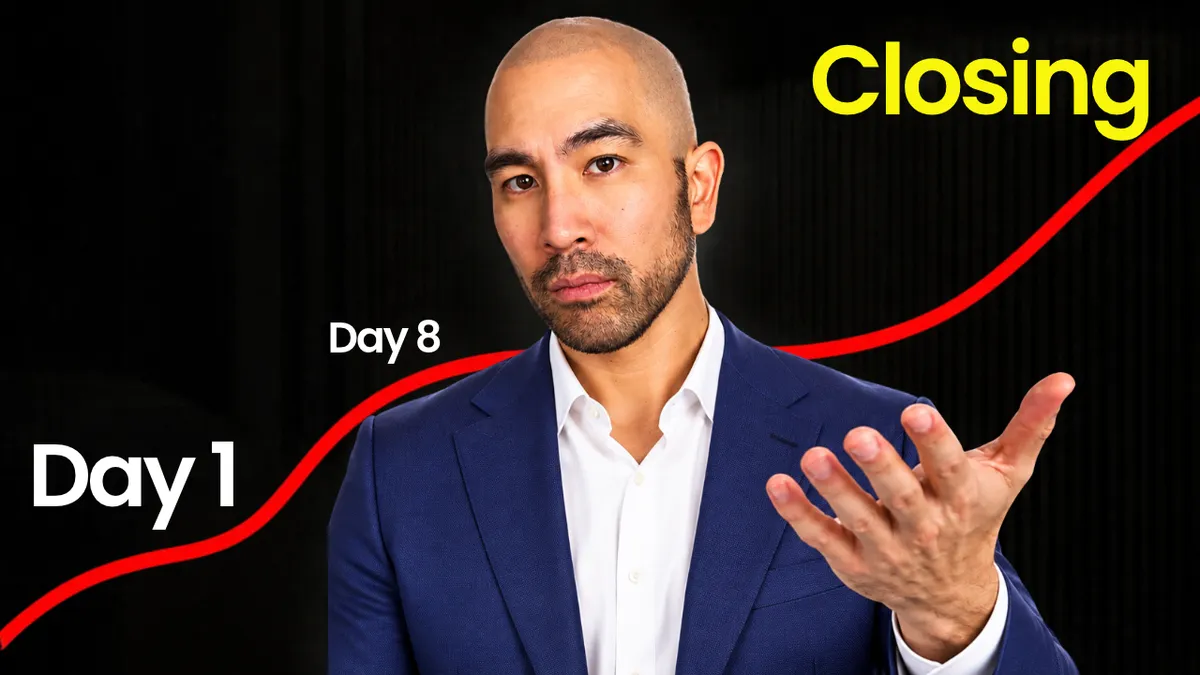
How to Ramp a New Sales Rep in 90 Days (Instead of 157)
Why does it take so long to ramp a new sales rep?
When I ran sales teams inside a Fortune 500, our standard ramp time was 157 days. That was the number on the plan. We budgeted headcount against it and nobody ever asked whether it had to be that long.
It didn't. I got my teams under 90 days. Reps booked meetings in week two and closed their first deals inside 30.
The reason most ramps run long has little to do with how complicated the product is. It's that nobody ever decided what week three was supposed to produce.
What does a slow ramp actually cost?
Use your own numbers. Say the rep carries a $1M target.
Six months in they should be near $500K. Say they closed $100K. That is $400K of production you planned for and did not get, from one person, in half a year.
If they last the year and finish at $200K, that is $800K in lost production.
And if base and benefits run $100K, that rep cost the business $900,000 to produce $200K. That is a bad investment on its own.
Most people stop there. Keep going.
Put your real margin on it. At 20%, that $800K gap is $160,000 of profit that never showed up. Ask what $160,000 of profit was supposed to do this year. Another rep. A product hire. Marketing dollars. The infrastructure you keep pushing to next year because the cash is not there. Or straight cash in the bank. It is not there because it is sitting in a territory nobody worked.
Run it with two reps ramping slowly at once and double all of it.
So three costs stack:
Direct. Five or six months of salary before anything comes back. Everyone sees this one.
Indirect. The backfill. Replacing them runs 100% to 200% of base salary once you count recruiting, your time, and the empty seat.
Opportunity. The $160,000 of margin that was going to fund the next move. This one compounds, because it delays everything that money was supposed to buy.
Then there is the part that restarts the loop. Someone with nothing closed by month four knows it. So does everybody else. They go quiet in the pipeline meeting, they start updating their resume, and they might quit before you ever let them go. Then you hire again, and the new person inherits the same nothing.
I spoke with a founder recently who has run that loop 75 times in 18 years.
Isn't onboarding just product training and shadowing?
That's what it is at most companies. Day one, laptop and a login, if the laptop showed up. Days two through five, product training, which usually means read this slide deck and these info sheets. Week two, sit in on calls with whoever has time. Week three, live.
Two problems with that.
The shadowing problem: they sit with whoever's available, which is usually a middle performer, and they copy that person down to the habits.
The newer problem catches the founders who are actually doing the work. Some have built the playbook. Then they hand it over on day one and say read this. Reading a playbook and running one are separated by a few hundred repetitions. Nobody ever learned to drive from the owner's manual.
What are the 12 weeks of the 90-Day Fast Ramp?
The system below is what we call the 90-Day Fast Ramp. Twelve weeks, each with one thing that has to be true before anyone moves forward, ending in a live certification.
What should happen before day one?
Zero logistics on day one. If a new hire spends their first morning fighting a laptop or waiting on a CRM license, the week is already lost.
Laptop ships to arrive three days early and they confirm login before day one. Email, CRM with correct permissions, prospecting data tool, video conferencing, calendar access, call recording. All live before they start.
Then block the calendar: four-hour training blocks 8 to 12 for week one and the first two days of week two, call blocks from week two Wednesday, and a recurring weekly 1:1 from week three Friday.
Two things stay off the calendar. No company-wide staff meeting for the full 90 days, and no other department heads in weeks 1 to 3. Their job right now is the playbook, the phone and the deal.
One more: mail a physical letter to their home, addressed to their spouse or partner, describing the reward they get for passing the 90 days. It arrives in week one and creates accountability you did not have to manufacture.
What does day one look like?
The order matters more than the content.
8:30 team meeting. 9:30 a 30-minute 1:1 where you set expectations for day one, week one and the 90 days. 10:00 they write their Success Blueprint, their personal goals, and you keep it. 11:00 HR paperwork. 12:00 lunch, no business. 1:00 resource walkthrough. 4:00 check-in. 5:00 their first daily learnings email.
The Success Blueprint looks soft and it is the most useful item on that list. In week eight, when a rep is under-performing, most managers pull out a KPI report and the rep gets defensive. Pull out what they wrote on day one instead: "You told me you wanted to retire your wife by forty. I am letting you down as your coach if I do not help you get there." That conversation goes somewhere a quota lecture never does.
Week 1: Immersion
Four hours a day of live training with the leader, 8 to 12, walking the playbook section by section on a shared screen. Afternoons are self-study and script practice.
Every day by 5pm, a written email: top five things learned, how each will be applied, questions still open. Fifteen minutes for them, and you read and respond to every one.
This is the cheapest early warning system available. By Wednesday you know whether someone internalizes or performs enthusiasm, because takeaways are either specific to your business or generic, and nobody fakes it five days running.
Exit condition: Friday of week one they articulate who you sell to, the problems you solve, why a customer picks you over the next option, what a good cold call sounds like, how to handle your common objections, and how discovery and your sales process work. With no notes.
Week 2: First live calls
Playbook finishes Monday and Tuesday. Live dials begin Wednesday. That is day eight.
The rep dials from a list they built, using the process already written in your playbook. The leader is on the call muted, listening, coaching between dials rather than during them. Booked meetings go on the leader's calendar, or on the calendar of a top rep who executes the playbook well, so the new hire watches a great discovery call run on a prospect they sourced themselves.
Practice is real plays. A real play simulates the worst version of the call: four objections in a row, a buyer who will not open up, a rude gatekeeper. Soft practice builds a confidence that breaks on first contact.
Exit condition: three days of live call blocks behind them and at least one qualified meeting booked.
Week 3: Independence
The rep owns prospecting blocks and books on their own calendar. They run their own discovery calls with the leader attending as a silent observer who debriefs afterward and does not take over.
The daily email or Slack message continues so you can see development progressing week to week. Friday brings the first weekly report and the first weekly 1:1.
Exit condition: 2 to 4 qualified meetings booked, at least one discovery run independently, first opportunities in pipeline.
Week 4: Install the week
Daily training ends. Daily emails end. The rep gets their week handed to them hour by hour: protected prospecting hours, call prep, deal work, CRM updates.
Most reps cannot describe their ideal week. They drift between prospecting, admin and meetings. Even at 60% adherence to a designed week, they out-work most of the field.
Exit condition: 4 qualified meetings, running discovery alone on half their calls, the week loaded as recurring calendar blocks.
Weeks 5 to 12: the two checkpoints
The rep owns the week. Management runs through the weekly 1:1 and a hand-filled weekly report. Hand-filled on purpose: typing "revenue closed: $0" creates urgency a dashboard never will.
The 1:1 never gets cancelled. If Friday does not work it moves to Thursday. The moment consistent 1:1s stop, consistent performance stops with them.
Half a day a week the leader sits on live calls. After each: three things done well, three to work on, clear action items into the next call.
Week 7 checkpoint. Zero qualified meetings booked by week seven is a serious red flag and triggers a direct conversation about fit. The math does not work if they cannot get in the door.
Week 10 checkpoint. Formal go or no go. Healthy pipeline and a first deal closed or close to it. Empty pipeline with no momentum means the week 12 outcome is already decided.
Without those two dates, time runs away from you. It can be six, eight, even twelve months before you look up and realize how far behind someone is. I spoke with a founder last month whose under-performer had been there two years producing 20% of what everyone else did, and she had not registered it until we put the data in front of her.
By then you have paid months of salary and the territory has gone unworked.
What is Founder Grade Certification?
At week 12, a live end-to-end run with senior leadership. Cold call through close, real objections, no notes, scored against the playbook frameworks, followed by a walkthrough of their top three live deals.
Alongside it sit the induction criteria, agreed on day one: at least one deal closed, averaging four qualified meetings a week from week five, a real pipeline number, weekly reports in on time with no misses, playbook knowledge without notes, and coachability.
Then the decision. You answer one question independently: "Do I want this person on my team for the next three to five years?" Anything less than a hell yes and the hire does not pass.
Passing should be an event: framed certificate shipped home, branded merchandise, company-wide announcement, and the reward from the letter mailed before day one.
What should I do this week?
Twenty minutes.
Take your most recent hire. Write down what they could demonstrably do at the end of week one, week four and week twelve. Demonstrably, meaning you could have sat there and watched them do it.
Most founders stop at the second line. That is the exercise, and that is the answer.
They didn't have a ramp. They had a start date.
Then pick one thing and install it before your next hire. If you only take one, take the daily email in week one. Ten minutes a day, and it tells you inside five days who you actually hired.
FAQ
How long should it take to ramp a new sales rep? Ninety days to full productivity is achievable for most B2B teams. A 150-plus day ramp usually reflects an undefined onboarding process rather than a complicated product.
What is the 90-Day Fast Ramp? A week-by-week onboarding system for new sales reps. Each of the twelve weeks carries one condition that has to be true before the rep advances, with formal checkpoints at week 7 and week 10 and a live certification at week 12.
When should a new sales rep start making live calls? Week two. Waiting seven weeks means the muscle never builds properly. The rep will be bad on the phone at some point either way, and week two with a manager listening is the cheapest place for it to happen.
Should a new sales rep shadow your top performer? Shadowing whoever has a free hour usually means copying a middle performer. Structured call blocks with the leader listening, plus a curated library of recorded calls, transfer far more.
What should a new sales rep accomplish in their first week? Articulate your ICP, the problems you solve and your differentiators without notes, and be ready to dial Monday of week two.
When do you know a sales hire is not working? Week seven. If they have not booked a single qualified meeting by then, that is when the conversation happens. Without a fixed checkpoint, most owners do not register how far behind someone is until month eight or later.
If you want our help to install a custom onboarding system for your team, go ahead and book a call below.