
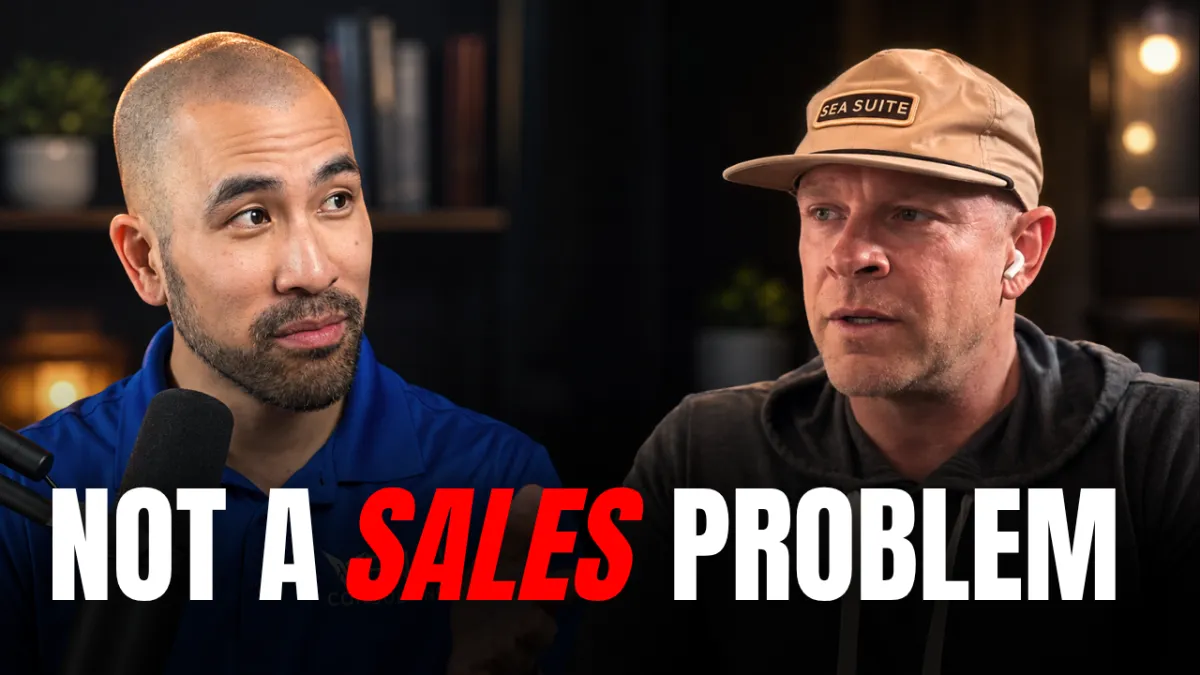
Your Sales Problem Probably Isn't a Sales Problem (What 200 Diagnosed Sales Teams Reveal)
Your number missed. The conversation that follows is always the same. The team needs more training. The reps are not good enough. The product needs work. Marketing is not sending enough leads. Someone redesigns the comp plan. Six months later, the gap looks identical.
Nigel Green has watched that loop run hundreds of times. He is the CEO of Sea Suite, spent 12 years in advisory work after a career as an operator, and has assessed 200 sales teams. He also wrote the book "How to Hire Elite Salespeople." On The Revenue Vault, he gave Marcus Chan the pattern underneath all of it. Sales is almost never the problem. It is the symptom.
Sales is usually a symptom of something structural
When a CEO hires Nigel to fix sales, he treats the first conversation the way a good doctor treats a patient. The patient walks in and says, "I know what is wrong. Sore throat, runny nose. Give me the antibiotic and let me leave." No competent doctor writes that prescription. They listen. They examine. They ask questions. Then they find what is actually going on.
Nigel does the same. He asks one question early. "Could you be open-minded that what you think is your issue is really a symptom of something else?" Most leaders say yes. Then he walks them through 27 data points built from assessing 200 sales teams. More often than not, the real problem is not even in the same area code as the one they walked in with.
The structural decisions hiding behind "sales problems"
What counts as structural depends on the stage of the company.
Early stage, pre-revenue to a couple million in revenue, the founder is still selling. The questions are basic and heavy. Do I hire my first rep, and why? Is this even a sales problem, or do I need support augmenting myself? Is it lead generation or lead closing? Sometimes the answer is that you do not need more customers at all. You need to sell your current customers something else. Nigel points at SaaS companies that spend enormous sums chasing new logos while ignoring deeper expressions of the product that would entrench them with the customers they already have.
Mid stage, the trap is the first sales leader hire. The instinct is to promote the best rep. Nigel calls that the worst move you can make, and he has a clean way to explain why. Michael Jordan does not coach. LeBron James never will. Bill Belichick, Pete Carroll, and Nick Saban are great coaches, and nobody remembers their playing careers. The skill that builds a great rep is a different skill from the one that builds a great leader.
Large companies, high teens to hundreds of millions in revenue, the decisions get heavier still. Sell now or hold two more years. Carve out one piece of the business and sell that. Raise more money and double down. Sales can feel like the problem in every one of these situations. It is a symptom of a design flaw nobody has addressed.
The real root cause is a leader who will not decide
Run the diagnosis long enough and it deduces down to one to three structural decisions. Nigel hands the leader Path A and Path B, both of which they could live with. After 10 or 12 years of watching some CEOs decide and some not, the pattern he sees is binary. You are willing to make a call that may be unpopular, where the information is not clear and consensus is not coming. Or you are not.
"Stuck" has a precise meaning in his work. It is circling the same decision for too long.
What keeps leaders stuck is not a skills gap. No executive ever told Nigel, "I do not know how to do hard things." They all know they can. The real question is quieter. Am I willing to stomach failure? Can I live with this not going the way I thought it would?
That indecision carries a cost. Hold times in private equity stretch out. Valuations come in lower. Management teams churn. Easy capital after COVID hid a lot of it, because burning cash on SDRs and leads looked like progress. That era is over. The market rewards real value creation now, and that is hard work.
Decisiveness is a skill you can train
The part most leaders miss: the ability to decide under pressure is trainable, and the training happens outside of work.
Nigel spends 100 or more days a year on the water. Surfing and fly fishing both punish hesitation. The wave is here, you commit or you miss it. The fish is moving, you cast now or the moment is gone. He found that the conditioning carries straight into the boardroom. He does not stay stuck for long, because he practices deciding and living with the result somewhere the stakes are physical and immediate.
Every stuck CEO he has worked with had something similar, a pursuit outside work that got them unstuck. It was not always the water. There was always something.
This is also where courage gets defined correctly. People assume courageous leaders feel no fear. The opposite is true. Courage only exists when there is fear. Courage is doing it scared. Elon Musk and Steve Jobs were scared often. They moved anyway.
The playbook is not always the problem
One more reframe, this one for sales leaders specifically. Average tenure for a VP of Sales or CRO sits near 18 months, which maps almost exactly to head coaches in pro sports. The lesson from great coaches is simple. They read the players they have and adjust the playbook, rather than spending six months and a pile of cash replacing everyone to run the play they showed up with.
So before you tear the team down, ask a sharper question. Is it the playbook that has to change, or is it your relationship with the playbook? The market moves fast enough that you will be running a new play in six to eight months regardless. The leaders who last get comfortable learning new plays as they go. That is what makes them worth keeping.
FAQ
Why isn't more sales training the fix for a sales problem?
The visible sales issue is usually a symptom. Training a team to run harder through a structural flaw does not close the gap. It moves more activity through the same leak.
What does Nigel mean by a "structural decision"?
A decision about the design of the business. Who to hire and when. Whether to go deeper with current customers or chase new ones. Whether to sell the company or double down. Sales performance sits downstream of these.
What does "stuck" actually mean?
Circling the same decision for too long. The options exist. The willingness to choose one and live with the outcome does not.
How do you get unstuck?
Build the muscle outside of work. Nigel uses surfing and fly fishing, sports that reward fast decisions under pressure. The point is having somewhere the cost of hesitation is obvious, so deciding becomes a habit.
The Bottom Line
Most "sales problems" are structural decisions nobody wants to make. The diagnosis tends to be clear. The follow-through is where leaders stall. If your number keeps missing and the fixes keep failing, the constraint is probably one or two decisions up the chain, and the work is being willing to choose.
If you lead a B2B sales org and you want an outside read on where your real constraint sits, book a free Executive Snapshot below.
For the full conversation with Nigel Green, watch the episode embedded at the top of this post.


Mail
Facebook
LinkedIn
X
Pinterest
Snapchat
Reddit