
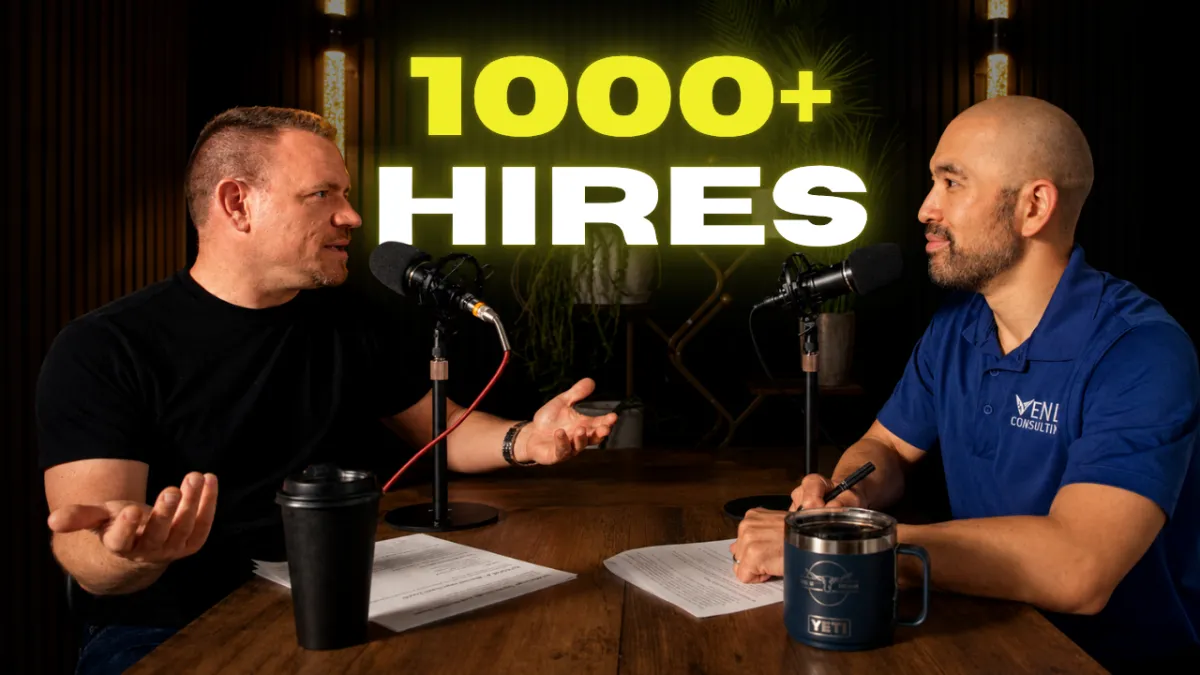
How to Hire B2B Sales Reps: The Framework Behind 1,000+ Hires
Most B2B sales leaders hire on results. The ones who consistently build top 1% teams hire on something else.
After 1,000+ sales hires, 5,000+ interviews, and 5,000+ one-on-ones across 25 years, Travis Smith has spent more time evaluating sales talent than most operators will in five careers stacked together. Dozens of the people he hired now run their own companies as CEOs, VPs, and founders.
He came back on The Revenue Vault to walk through the framework that actually predicts a top performer. Here's the full playbook.
TL;DR: The Sales Hiring Framework in 30 Seconds
The #1 lie B2B sales candidates tell in interviews is "results." Back into the math: cold calls, closing ratio, deal size, attribution.
Real plays beat role plays. Drop candidates into a live scenario inside the interview room.
The actual predictor of a top 1% performer is confidence in the moment, not the resume.
Interview 5 to 10 candidates a week even when you're fully staffed.
The retention question is "Where are you going?" Not in the company. In life.
Who Is Travis Smith?
Travis Smith is a B2B sales leader and coaching architect who has personally hired over 1,000 salespeople across 25 years. He's conducted more than 5,000 interviews, run more than 5,000 one-on-ones, rebuilt four sales teams, helped 3X a multi-million-dollar division, and spent 11 years building one of the only formal coaching functions inside a 450-employee B2B company. Dozens of the salespeople he hired have gone on to become CEOs, VPs, and founders.
What Is the #1 Lie B2B Sales Candidates Tell in Interviews?
The lie is "results." Most candidates inflate or take sole credit for quota numbers that came from team accounts, marketing-sourced pipeline, or territories carried by national reps.
Travis's filter is simple. Back into the math. How many cold calls a day? Closing ratio? Average deal size? Where did the 142% really come from? If the rep can't reconstruct how the number got made, the number isn't duplicatable. And if it isn't duplicatable, it won't repeat on your team.
Most hiring managers feel fear around asking the harder follow-up and skip it. Travis says the opposite. If you feel fear about a question, that's the signal to ask it.
What Are "Real Plays" vs Role Plays in Sales Interviews?
Real plays are live scenarios candidates run inside the interview itself, with no script and no preparation. Role plays are hypotheticals candidates describe verbally.
Travis gives candidates live sales objections and says "go." He doesn't want a script. He wants to see what they do when nobody's coaching them through it. Then he asks the candidate to self-evaluate. What did you do well? What would you change? Then he has them run it again.
The combination of live execution, honest self-assessment, and a second attempt tells him everything about coachability in under 10 minutes.
What Predicts a Top 1% Sales Performer?
Confidence in the moment. After 1,000+ hires, Travis says the single biggest distinguishing factor between top performers and average reps is the level of confidence they bring when it's time to perform.
That changes the job of a sales leader. Your job isn't to fix the rep. Your job is to be a confidence giver. Most leaders do the opposite. They yell fundamentals from the sidelines on the drive to the meeting. That's a manager managing their own anxiety, not building a performer.
The Travis version: "You've practiced this. Be you. You got this." Then the rep makes the call. The point is that next time, they don't call you for permission.
How Often Should a Sales Leader Interview Candidates?
5 to 10 interviews per week, even when fully staffed. Over 25 years, that cadence is how Travis hit 5,000+ interviews. It isn't a heroic effort. It's a weekly rhythm.
The worst time to interview, in Travis's words, is when you need somebody. That's when desperation lowers your bar. The leader who interviews steadily is never desperate. The one who doesn't is always one resignation away from a bad hire.
Most internal and external recruiters will give you 3 to 4 candidates. Travis pushes back. He wants 8 to 10. The wider the funnel, the sharper your radar gets.
How Do You Retain Top Sales Talent?
Ask "Where are you going?" Not where in the company. Where in life. Align the rep's development plan to their long-term goal, even if that goal eventually pulls them out of your org.
Travis tells the story of a rep whose father owned an engineering firm. The rep was going to inherit it. Most managers would've coded that as a flight risk and disengaged. Travis aligned the development plan to the skills the rep needed to eventually run his dad's business. He stayed four years. He gave full discretionary effort. He left on great terms, and he still calls Travis.
Turnover happens because of a gap between what you offer and where the rep is actually trying to go. Close the gap and the gap stops closing them.
What's the Difference Between Illuminators and Diminishers in Sales Leadership?
Illuminators shine the light on the other person and ask the next question. Diminishers top every story with their own. The phrase comes from David Brooks. Travis applies it to coaching.
"When I was a rep…" is the diminisher tell. Reps don't care what their manager did as an individual contributor. They care whether their manager sees them. The best sales leaders forget who they were in the seat and put the focus on the rep in front of them.
Why Cutting Sales Commissions Costs More Revenue Than It Saves
Most CFOs see commission as a cost line and try to compress it. Travis sees it differently. Lowering commission rates lowers the kind of talent you attract. A-players negotiate the commission plan because they believe they'll crush it. Reps who negotiate hard on base salary are negotiating around security. That's a yellow flag.
When companies cut commission to "save margin," they typically lose more revenue than they save. The math runs against them within two quarters.
FAQ: B2B Sales Hiring and Retention
Q: How many candidates should I interview for one open seat?
As many as possible to get the BEST fit. If you’re using an external recruiter? Drive them to provide 8 to 10 of the BEST ones, not the 3 to 4 most recruiters provide. The wider the funnel, the sharper your radar.
Q: Is real-plays the same as a working interview?
No. A working interview is a paid trial period. Real plays happen inside the interview room itself. Live, in the moment, no rehearsal.
Q: What if a strong candidate negotiates hard on base salary?
Controversial but Travis believes that's a yellow flag. True achievers negotiate the commission plan, because they believe they can hit it.
Q: How do you handle a rep whose long-term goal will pull them out of your company?
Align their development to the skills they'll need next. You'll get more discretionary effort from a rep growing toward something than one who feels stuck.
Q: How do you build a coaching culture inside a non-SaaS, traditional B2B company?
You invent the function. Travis spent 11 years proving the coaching function inside a 75-year-old, 450-employee business, ending his tenure there as VP of Coaching, a role most operators still don't have a name for.
Want to Find the Revenue Leaks in Your Own Sales Org?
If your hiring is reactive, your coaching is inconsistent, or your top reps are quietly checking out, the fix isn't more training. It's a system.
Book a free 45-minute Executive Revenue Leak Snapshot. We'll listen to your calls, look at your pipeline, and tell you exactly where the money is hiding. Book it at the link below.



Mail
Facebook
LinkedIn
X
Pinterest
Snapchat
Reddit