


Why Do My Sales Reps Only Close Small Deals?
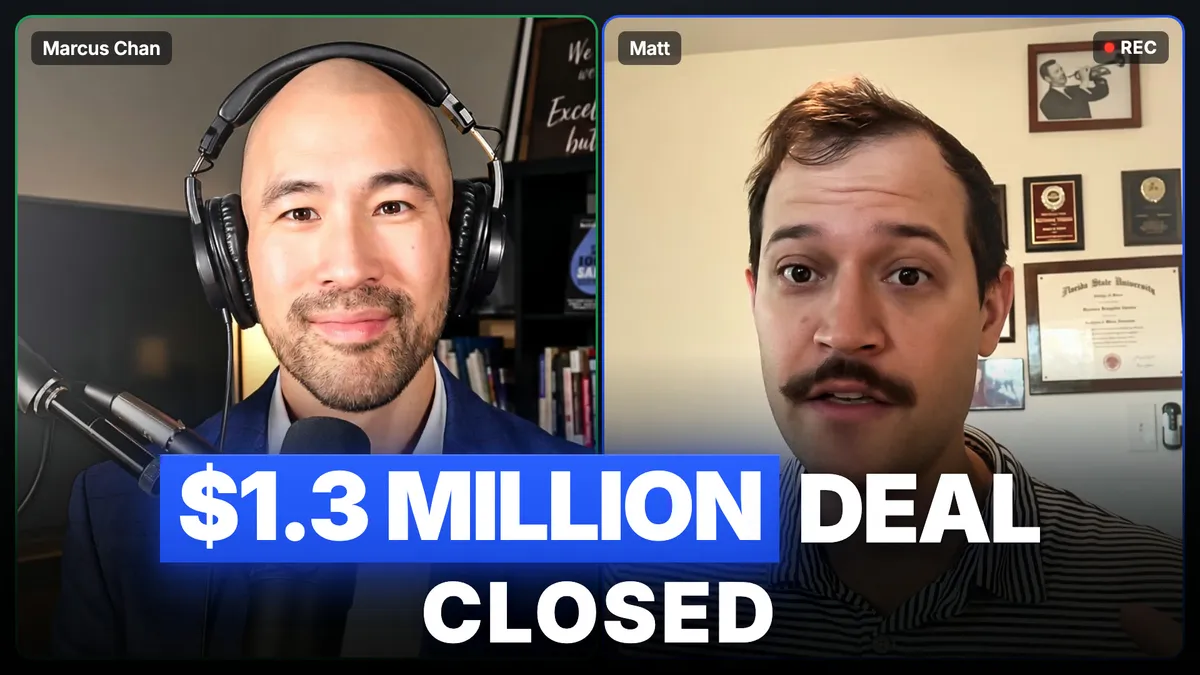
Executive Summary: Sales reps close small deals when discovery stops at the one product they know and the first person they meet. On a live coaching call, Marcus Chan, founder of Venli Consulting Group, rebuilt one rep's discovery from the first question. That rep went on to close a $1.3 million deal, 15 times his company's average deal and the biggest in its history.
You hired good reps. They work hard. They close deals every month.
Then you look at the numbers. Every deal is small. One product, one contact, one signature.
The bigger accounts take the meeting and go quiet. Or the deal lands back on your desk, and you close it yourself.
Matt sells accounting software to accounting firms. His company sells a whole suite of products and services around its core product. Matt won the small one-owner offices. The bigger firms, the ones with partners and real budgets, took the meeting and went quiet.
On our coaching call, he put it plainly: "I'm just selling teeny tiny deals, and I've got a 4X revenue target now."
Here is what we changed.
Why do sales reps keep selling only one product?
Sales reps sell one product because it is the pitch they know best. Nobody taught them to find problems for the rest of the suite. Matt felt his other products were "just not a fit, like, nine out of 10 times." So he tied every deal to the core accounting system and stopped there.
A rep learns the core product first and gets good at it. Every other product feels like a stretch, so it comes up late or never.
The cost shows up in three places on a founder-led sales team:
Deal size. One product means one small invoice.
Retention. A client who buys one product leaves more easily than a client running on three.
Margin. The complementary products and services often carry the best margins in the business.
How do reps get more products into a deal before they pitch?
Teach your reps to treat the full suite like a Batman utility belt. Every tool stays on the belt until discovery shows which one the buyer needs.
On the call, I told Matt the mistake to avoid: "what you don't do is start throwing them aimlessly out and kind of hoping something sticks."
The order matters. Start with the problems the core product solves. Only after those are clear, ask what other problems sit next to them. Each problem the buyer confirms becomes a reason the next product belongs in the deal.
For Matt, the next problem was paper checks. One accounting office he described was cleaning up 1,400 checks with no detail on what any of them were for. The October 15 tax extension deadline was a week away. The payments product solves that problem. It also gives the firm a new service line it can bill its clients for.
The rep never had to pitch an upsell. The buyer described the problem first, in their own words.
Do your reps only sell the product they know? Do the big deals still land on your desk? Book a Revenue Strategy Call.
What discovery question gets a buyer to explain how they run things?
Ask about the buyer's current process, then ask what happens when that process breaks. Most reps ask a yes or no question instead, like "Do you guys do any checks for your clients?" The buyer says the clients handle that, and the thread dies.
The better version, from the call: "Help me understand, what's their current process right now for most of those checks?"
Then follow the process with two more questions:
"What do you do when you get that check and there's nothing on the memo line?"
"Roughly, for your typical client, how many checks is that?"
When I gave Matt that first question, he stopped and said, "I'm gonna write that one down."
Process questions work because the buyer shows the rep where the friction is. The rep hears which product fits from the buyer, in the buyer's words, with the buyer's numbers.
How do I get my reps to show what the problem already costs the buyer?
Have your reps walk the buyer through the cost in the buyer's own numbers, one question at a time. This is the point where most reps open the slides. On this call, we spent the next few minutes on what those checks were already costing the firm.
Matt said many accountants were "stuck in status quo." So I asked him to describe one. He described a mid-sized office with $1.5 million in revenue, eight staff and two owners. Together, the owners took home about $500,000 a year.
Then I made the point that changes the conversation. Nothing ever stays status quo. A plant left alone in the yard keeps changing. So does a body, and so does a business. Keeping $500,000 of owner earnings flat takes effort every single year.
From there, the cost of the problem comes out in three forms:
Time. Staff chasing clients for missing check details.
Risk. Filing taxes on guesses, and the penalties that follow.
Money. Unbilled hours, and a client who leaves after a mistake.
Once the buyer says the cost out loud, the deal has a reason to move.
Will digging deeper on a first call scare buyers off?
Matt worried it would. He thought qualifying hard on a first call would push buyers into even smaller deals. A lot of reps believe the same thing and never bring it up in a pipeline review.
The answer on the call was to get the partners to admit the problem first, then tie it to the bigger goal. Questions about the buyer's own business keep the buyer talking, because the buyer is the expert on that.
Why do bigger deals with multiple decision makers stall?
Bigger deals stall when the rep sells a department problem and the partners decide on a company or personal goal. Matt summed up the buyer's objective as "less manual process, more money." I told him that was a department problem. Partners think about the big picture.
The partners at a bigger firm might want to grow earnings from $5 million to $10 million. Some plan to sell the business. Some plan to hand it to family.
Matt's deals also needed what I call a conceptual sell. The firm had to accept a new way of running its business, like offering bill payments as a paid service. Decision makers only buy a new way of working once they agree there is a problem.
How do I find the personal reason a buyer signs?
Ask what the business goal means to the buyer personally, then wait. A partner will happily give you a revenue target. Somewhere behind that number is what they'd change about their own week.
Here is how the role-play on the call ran:
Rep: "If you're able to go from 5 to 10 million, what does that mean for you?"
Buyer: "I get a bigger paycheck."
Rep: "You're already successful. Would that change anything in your life?"
Buyer: "I work 80 hours a week. I never get to take a vacation."
That last answer is the reason to buy. Then the rep closes the loop with a summary. "So if I understand you right, the big number is growing from 5 to 10 million. And the reason it matters to you is getting your time back. Is that right?"
I call this the Solution, Problem, Objective loop. Name the core solution. Tie it to a specific problem. Connect that problem to the big objective, business and personal. Then repeat the summary each time a new problem comes up.
What should a founder put in place so every rep runs this discovery?
Three things, run every week:
Written questions. Before a big meeting, the rep has the discovery questions written out, taken from the best calls your own team has already had.
A weekly live deal session. Each week, take the deal that's most stuck and work through it live with the rep.
A leader who learns to run it. Your sales leader sits in until they can run that session themselves.
Most companies try to fix discovery with a training day. A week later the reps are back to pitching the one product they know. What makes it stick is someone reviewing your reps' live deals every week.
What's the difference between small-deal and big-deal discovery?
Big-deal discovery goes past the first product and the first contact, all the way to the personal reason the partners sign.
Step | Small-deal discovery | Big-deal discovery |
|---|---|---|
First question | "Do you handle X?" | "Walk me through your current process for X." |
Products | Pitch the core product only | Uncover the problems the full suite solves |
Pain | "It saves you time" | Time, risk and money in the buyer's numbers |
Who it serves | One department | The partners and the company goal |
Why they sign | Logic only | Logic plus the personal reason |
Close | Send a price | Summarize problem, cost and objective, then confirm |
Matt kept working these moves, along with the rest of his coaching. He went on to close a $1.3 million deal. That deal was 15 times his company's average and the biggest in its history.
Frequently Asked Questions
When does a deal's size get decided?
Usually in the first ten minutes of discovery, long before anyone sends a price. The questions a rep asks early decide how many problems, products and people end up in the deal.
How long does it take to fix small-deal discovery?
The questions change in one coaching session. Matt left a single call with new questions to use on his next deal. Turning them into a habit takes weekly practice on live deals, reviewed by someone who knows what good sounds like.
What if I only have 2 reps?
The fix is the same with 2 reps or 20. Write the discovery questions down, practice them on real deals, and review one big deal per rep every week.
Should I still join big deals as the founder?
Join a big deal to coach the rep, and let the rep run the call. Every deal you close yourself teaches your rep to hand you the next one.
Is selling more of the suite to one client worth the effort?
Yes. A client who buys more of your suite spends more, stays longer and usually carries better margins. Matt's biggest deal was 15 times his company's average.
What is a conceptual sell?
A conceptual sell asks the buyer to change how they run their business. Adding a new paid service is one example. The buyer has to accept the problem before any product makes sense.
How do I stop my reps from pitching too early?
Give them one rule. No product comes up until the buyer has named the problem, the cost and the goal in their own words.
If your reps still close small deals and the big ones keep stalling, book a Revenue Strategy Call below.
Marcus Chan is the founder and CEO of Venli Consulting Group. Venli helps founder-led B2B companies build a sales system their team can run without the founder on every deal. Before Venli, Marcus led a 110-rep, $195M sales org at a Fortune 500 company. He is the author of the Wall Street Journal and USA Today bestseller Six-Figure Sales Secrets, a 5x Salesforce Top Sales Advisor and a 6x LinkedIn Top Voice. Venli has served 700+ clients.