
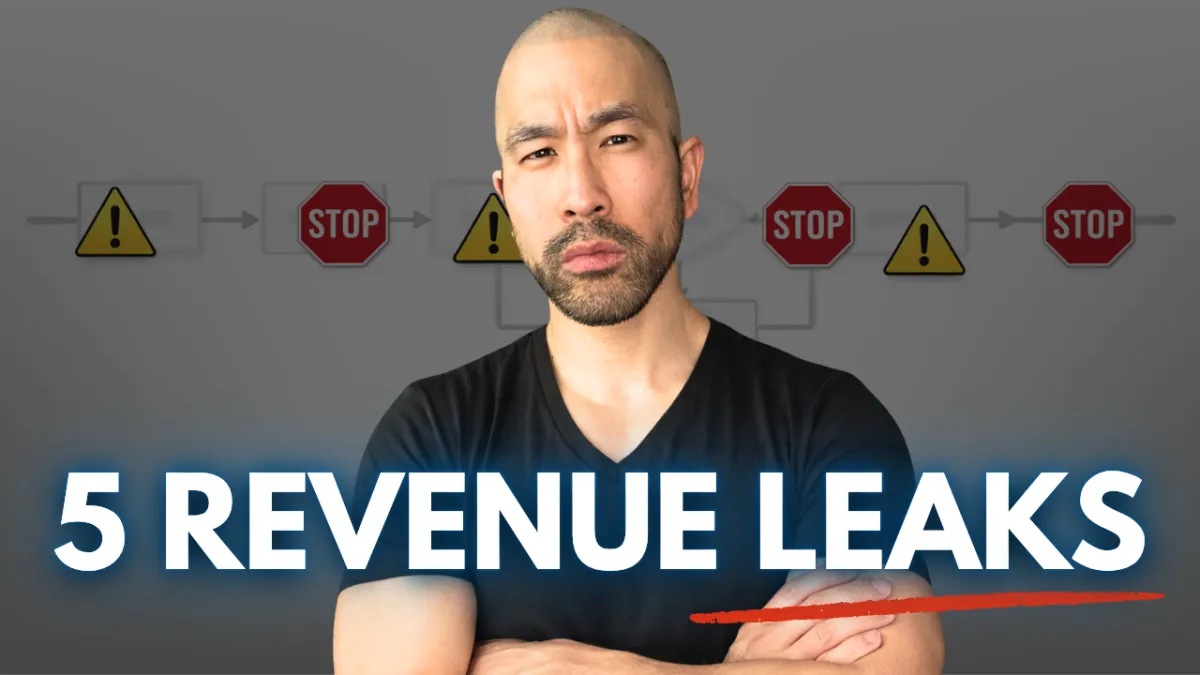
Why Your Sales Org Is Leaking Revenue (And Can't See It)
The average win rate across the B2B sales organizations I audit is 21%. Most of those teams should be at 35% or better. The gap is not a talent gap. It is a systems gap. And the reason most leaders cannot close it is because they are measuring the wrong things.
This post breaks down the five specific revenue leaks causing that gap, the math on what each percentage point of win rate is actually worth, and the four components that fix it without adding a single new headcount.
What Is a Revenue Leak in Sales?
A revenue leak is any structural gap in a sales system that causes a team to produce results below its potential given the quality of its people, its product, and its market. Revenue leaks are not about bad reps or bad products. They are process failures hiding inside otherwise normal-looking sales activity.
Most sales leaders cannot identify them because they are measuring outputs such as closed revenue and quota attainment, rather than the checkpoints between outputs where deals actually die. A team running three simultaneous revenue leaks will look busy, hit activity metrics, and still miss quota every quarter. Most have no idea why.
Why the Standard Fixes Do Not Work
When win rate stalls, most leaders reach for one of three moves: replace underperforming reps, buy a training program, or add headcount to cover the gap with volume.
None of those fix a stuck win rate. All three treat the problem as a talent or quantity failure. In most cases it is a structural failure. Adding better people to a broken system produces better people running the same broken process.
I worked with a VP of Sales at an HR tech company running a 15-person team with a win rate stuck at 21% for three consecutive quarters. She had identified two underperforming AEs and was preparing to cut them.
Before she did, we ran a full audit.
The reps were not the problem. Deals were advancing through pipeline stages without confirmed champions, validated budgets, or mapped decision processes. The system was generating bad forecasts and burning rep time on deals that were never going to close.
We fixed the system. Win rates climbed 47%. Deal velocity jumped 65%. One of the AEs she nearly fired hit 114% of quota in a single quarter after the changes.
Same rep. Different system.
The 5 Revenue Leaks Destroying B2B Sales Win Rates
1. The Qualification Leak
Reps are opening deals they should never open. They spend 60 days pursuing a prospect without real budget, real authority, or a real problem your product solves. The cost is not the lost deal. The cost is the 60 days of rep time that evaporated chasing it.
The fix is stage-exit criteria at the top of the funnel. Before a deal advances out of stage one, the rep confirms three things: a real problem, a real budget, and a real decision maker. If any of those three are missing, the deal does not advance.
2. The Sales Cycle Leak
The average sales cycle in the orgs I audit runs 30 to 45 days longer than it needs to. The cause is process inconsistency. One rep runs discovery in meeting one, another skips it entirely. One sends a proposal after two calls, another waits for five. Inconsistency creates drag, drag extends the cycle, and a longer cycle gives buyer urgency time to fade before you reach close.
3. The Forecast Leak
Deals advance on rep optimism rather than confirmed facts. A rep tells their manager a prospect seems interested and that becomes a stage-four deal on the forecast. By quarter end the number is wrong and the board wants answers.
The fix is confirmed checkpoints at every stage: champion validated, budget confirmed, decision process mapped, timeline established. A deal advancing because it feels good is not a forecast. It is a wish list.
4. The Close Rate Leak
Deals reach proposal stage and die. Three consistent causes: no alignment on value so the prospect treats the proposal as a commodity price quote, no multi-threading so one champion departure kills the deal entirely, and improvised objection handling with no repeatable system. Any one of those alone suppresses close rate by five to ten points. All three running together accounts for most of the distance between 21% and where a healthy sales org should be.
5. The Selling Time Leak
Your reps have 40 hours a week, roughly 8 to 5 PM on any given workday. These are what I call the Golden Hours for selling. In most orgs I audit, only 18 to 22 of those hours are actual selling motion: real calls, real demos, real proposals, real negotiations.
The other 18 to 22 hours disappear into administrative overhead, unnecessary internal meetings, and coaching sessions that produce no durable behavior change.
A 15-person team has 600 Golden Hours per week in theory. Most are extracting 300. They are running at 50% efficiency and cannot figure out why they are not hitting number.
The Math: What One Percentage Point of Win Rate Is Worth
Here is the calculation that changes every conversation about sales investment.
Fifteen reps. $50K average deal size. Twenty deals per rep per year. Current win rate: 21%. That is $3.15 million in closed revenue.
Move the win rate from 21% to 35% with the same team and same activity level. That is $5.25 million in closed revenue. The difference is $2.1 million annually. On that team, every single percentage point of win rate improvement is worth $150,000 per year.
The HR tech company referenced above added over $1.4 million in annual revenue from the same 15-person team after fixing the system. Deal velocity jumped 65% and win rates climbed 47%. No new hires, no new product, no new market.
FAQ: Revenue Leaks and Win Rate Improvement in B2B Sales
How do I know if my B2B sales org has revenue leaks?
If your win rate has been below 30% for two or more consecutive quarters, you almost certainly have at least one revenue leak running. The fastest initial diagnostic is identifying where deals are dying. Losses at proposal stage point to a qualification or close rate leak. Forecast misses above 20% per quarter indicate a forecast leak. Deals consistently running beyond 90 days before dying suggest a qualification or sales cycle leak. Most B2B sales organizations have at least three revenue leaks running simultaneously.
What is a realistic win rate improvement timeline after fixing the sales system?
Teams that install stage-exit criteria and a structured discovery framework typically see forecast accuracy improve within 30 days and win rate begin moving within 60 to 90 days.
The HR tech company in this post saw a 47% improvement in win rates after a full system installation. A fintech client reduced AE ramp time from 14 months to 6 months using the same core components. Timeline depends on how consistently the new system is reinforced through manager coaching rhythms during the first 90 days.
Why does sales training not fix a stuck win rate?
Training addresses knowledge. It does not address structure. If the system reps operate inside lacks clear qualification criteria, consistent process, and real coaching reinforcement, new knowledge degrades within 120 days. The reps know more but operate identically because the system around them has not changed.
High-performing sports teams do not just play games and hope for improvement. They review film, run drills, and practice real plays together every week. A sales team needs the same operating rhythm. Durable win rate improvement requires structural changes to the pipeline, the coaching cadence, and the forecasting process.
What four things should a sales leader fix before adding headcount?
Before adding reps, a sales leader needs a discovery framework that surfaces qualification gaps in week one rather than week eight, manager coaching rhythms built around weekly 1:1s, call reviews, and team training on real plays, stage-exit criteria that advance pipeline on confirmed facts rather than rep confidence, and a real-time dashboard that shows pipeline health by stage rather than just closed revenue at quarter end. Adding headcount before those four are in place means hiring more people to run the same broken process.
What are the Golden Hours in sales and why do they matter?
The Golden Hours are the core selling hours in a rep's workday, roughly 8 AM to 5 PM, when decision makers are reachable, deals can advance, and revenue-generating activity can actually happen.
Most reps have 40 Golden Hours per week available but spend only 18 to 22 of them in actual selling motion. The rest disappears into administrative tasks, internal meetings, and unproductive coaching sessions. Protecting and maximizing Golden Hours is one of the highest-leverage levers a sales leader can pull without changing headcount, territory, or product.
Your win rate is not stuck because your reps are underperforming. It is stuck because your sales system has structural gaps that no amount of hiring or training will fix.
If you are a CRO or VP of Sales running a 5 to 25 person B2B team with a win rate stuck below 35%, the fastest next step is finding out exactly where your system is leaking.
Book a free 45-minute Executive Snapshot at venliconsulting.com/teams. You will leave with your top three revenue leaks identified and a one-page memo ready for your CEO or board. If you do not rate it a 9 out of 10, we pay your hourly rate.



Mail
Facebook
LinkedIn
X
Pinterest
Snapchat
Reddit