
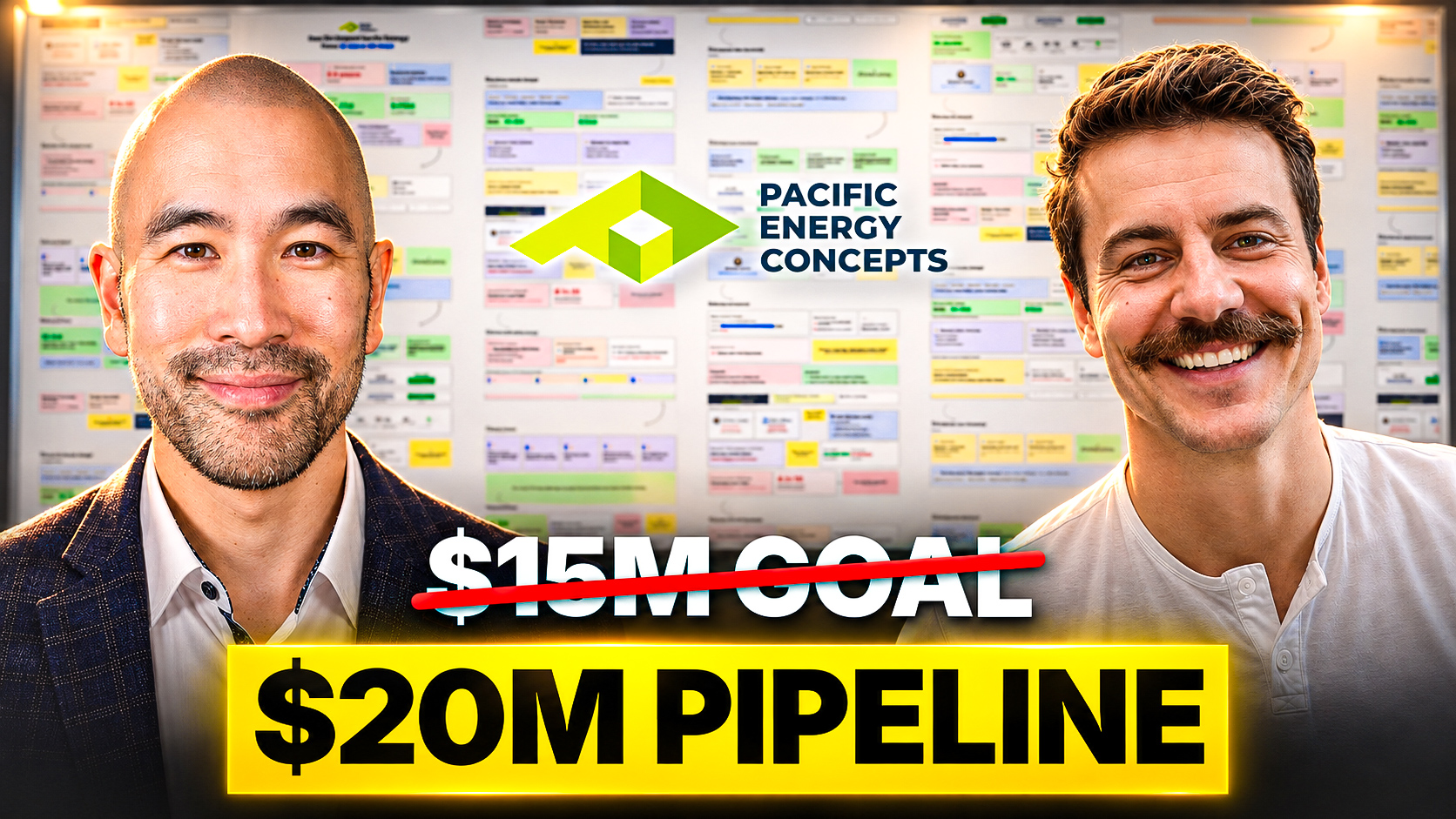
Pacific Energy Breakdown: $1.6M Closed in 90 Days
Company | Pacific Energy Concepts, energy-saving lighting upgrades for commercial buildings in the Pacific Northwest |
Team | About 25 in sales under two directors. We worked with six reps and both directors |
Starting point | About 4 in 10 proposals closed. New reps took up to two and a half years to ramp |
Result | $1.6M closed in 90 days against a $1.5M stretch goal. $20.6M in new pipeline against $15M |
Two years later | A VP of Sales, a team of 35 to 40 and a 180-page playbook |
Why does my team know the product cold and still lose deals?
Product knowledge wins the site walk. Then deals stall in the stages nobody tracks. At Pacific Energy, reps sent proposals before they knew who made the call. A daily tracker, weekly one-on-ones and a new standard for big deals closed $1.6M from 19 separate deals in 90 days.
The situation
Pacific Energy Concepts sells energy-saving lighting upgrades to commercial buildings in the Pacific Northwest. Think warehouses, plants, retail stores and office buildings.
Their sales org was about 25 people, split between two sales directors, Brandon Jones and Clark Phillips. We worked with six of their reps, three from each team, plus both directors.
These reps were strong on the technical side. They could walk a site, count every fixture, measure the light levels, and show an owner what the building would save.
The leaders were sellers too. On our first call, Brandon told me he, the other director and their president had all grown into strong salespeople. Nobody had ever taught them how to build other strong salespeople. In his words, they'd fumbled their way into it.
The challenge
Their best reps did several million a year each. New reps took one to two and a half years to ramp. When a new rep didn't work out, they often didn't know it for a year. That's a year of salary and a year of territory gone.
About 4 in 10 proposals closed. The rest went quiet, or came back months later through a different contact.
Brandon put it best when we talked again later. They'd hire good salespeople, and those people would show up and ask why nothing was working. His answer was, "It's not you, it's us."
What they'd already tried
They'd tried to fix it with hires. More than once, they brought in sales leaders from big Fortune 500 companies. Those leaders knew how to sell, and none of them built a process the team could repeat.
Then they asked me for a training. Their sales kickoff was a couple of weeks out, and they wanted a two- or four-hour session.
I told them to hold off. A training feels great on the day, and then people keep maybe 5 or 10% of it. The trainer flies home, and the team is left holding the bag. So we started with six reps for 90 days, and we looked at their real deals every week.
What we found
Four gaps, all in how deals got run and coached:
Nobody tracked the stages in between. They knew what they'd proposed and what they'd closed. When I asked how many first meetings turned into deals, Brandon said he'd have to look it up.
Reps were single-threaded. One rep had a proposal out for a facility in South Carolina. The facilities director rescheduled seven or eight times. The CFO, who'd sign the check, had never been in a meeting.
Qualification came after the proposal. Buyers treated them like a contractor bidding on a remodel. Reps built full proposals before they knew the pain, the timeline or who decides. That's how one rep lost a project to a cheaper bid with a slightly different spec.
One-on-ones were status checks. A manager asked where a deal stood, heard it was moving, and went on to the next one.
None of those gaps would have shown up in a two-hour training.
What we changed
#1 A daily tracker. Each rep logged their numbers at every stage, from cold calls to intro calls, discovery, site audits and proposals. It took less than a minute a day. Within a few weeks, each rep could see their own conversion at every stage, right next to the rest of the team. A Slack reminder went out at 4 PM every weekday: update the tracker and post one win or one lesson.
We also set two 90-day goals inside the tracker, so everyone could see the gap every day. They didn't run tight quotas, so we started around $1 million in closed revenue and pushed it to $1.5 million. We stretched the pipeline goal the same way, to $15 million.
#2 A weekly rhythm for the directors. The weekly team meeting covered actual against target, wins and lessons, and role-plays on live deals. Each rep also got a weekly one-on-one that covered actual against target, found the gap, set a plan and cleared whatever was in the rep's way.
#3 A new standard for big deals. Before a proposal went out, the rep had to know every stakeholder, what each one cared about, and how the decision would get made. On the South Carolina deal, that meant reaching the CFO before chasing the facilities director again. On a deal stuck with a landlord, it meant bringing the landlord in early, since the lease had to allow the project.
Does your team know the product cold and still miss the number? Book a Revenue Strategy Call.
What the team put in
Daily: each rep updated the tracker and posted a win or a lesson in Slack. A few minutes, visible to the whole team.
Weekly: a 50-minute coaching call with me. Reps brought their own stuck deals, and we worked them live in front of the group.
Over the 90 days: each rep sent in six call recordings for review. Each review showed the rep what to fix on the next call.
There wasn't much pushback. This was a technical team, and they liked having real numbers to look at.
The directors had the bigger change. They ran the weekly team meeting, plus a one-on-one with every rep every week, using the tracker as the starting point. In each one, they asked what the next step was, who it was with, and what could get in the way.
The results
The first few weeks: follow-up moved first. Reps were waking up deals that had gone quiet for months, with short emails and texts asking if the project was still a priority.
September: the big month, with about $780,000 closed.
The biggest win: a national manufacturer. One rep got to their VP of Sustainability, and they picked Pacific Energy for all 30-plus of their North American sites.
Day 90: $1.6 million closed against the $1.5 million stretch goal, and $20.6 million in new pipeline against $15 million.
How do we know it wasn't one lucky deal? That $1.6 million came from 19 separate deals. Every one of the six reps closed at least one, and no single deal was over $250,000.
Activity in 90 days | Count |
|---|---|
Cold calls | About 2,800 |
Decision-makers reached | 428 |
Intro calls from cold calls | 99 |
Intro calls from cold email | 44 |
Discovery meetings | 64 |
Deals closed | 19 |
That's about 3 in 10 discovery meetings turning into a signed deal. A few of those deals started before we got there, so treat it as a rough number. For projects this size, it's a strong rate.
About two years later, I had Brandon on my podcast. He'd been promoted to VP of Sales, and the sales team had grown to somewhere around 35 to 40 people. They'd built a 180-page sales playbook and hired a manager whose whole job is coaching new reps through their first year. Their outbound call scripts are still built on the framework we taught them.
The honest part
Effort wasn't even. One rep made more than 1,600 cold calls in the 90 days, and another logged about 20.
They lost deals too. One went to a cheaper bid even after good discovery. Another big project was paused by leadership above the rep's contact. Late in the 90 days, more buyers told reps their projects were on hold, and November closed only one deal.
The close rate on proposals didn't change as fast. Two years later, Brandon told me the fastest way to double their revenue was still converting more of the proposals they already send.
If the directors had skipped the weekly one-on-ones, the tracker would have turned into homework nobody looked at. For this to work, a team needs leaders who run the weekly rhythm themselves, and reps who put their real deals in front of the group, including the ugly ones.
Is this your team?
Your reps can explain the product better than your buyers can, and still only about 4 in 10 proposals close.
Proposals go to the person your rep met first, and you find out late that someone else makes the call.
Buyers ask for a price before your rep knows why they want the project.
You know what you proposed and what you closed, and almost nothing about what happened in between.
Your one-on-ones are a manager asking where a deal is at and moving on to the next one.
If three or more of those sound familiar, look at how your deals get run and coached before you book another training.
Frequently Asked Questions
We just need a good kickoff training. Why not start there?
A training feels great on the day, and people keep maybe 5 or 10% of it. Pacific Energy skipped the kickoff session and started with live deals and a daily tracker instead.
Our reps are technical. Will they buy in?
There wasn't much pushback. A technical team tends to like having real numbers to look at.
What does this ask of my sales managers?
A weekly team meeting, plus a weekly one-on-one with every rep, using the tracker as the starting point. That was the bigger change at Pacific Energy, and the part that made the rest hold.
Was it one lucky deal?
The $1.6 million came from 19 separate deals. Every rep closed at least one, and no deal was over $250,000.
What if the economy slows down?
It did, late in the 90 days, and November closed only one deal. The team still beat its stretch goal.
Will this work in my industry?
Everything we build comes from your own calls and your own data, so it fits the way your buyers buy. We've run the same system in energy, cybersecurity, K-12 education, enterprise services, hardware and commercial pest control.
What if it isn't a fit?
Your first 30 days are built so your downside stays small. If by day 30 it doesn't feel like a 9 out of 10 to you, you stop there and keep all the work we've done.
Who is this for?
Owners with between 3 and 20 reps, whose leaders and reps will show up to the weekly sessions. If you're an individual rep looking for coaching, or you want a one-day motivational training, we're the wrong people.
If your team knows what it sells and still misses, book a Revenue Strategy Call below. We'll look at where your deals stall between first meeting and close, and what we'd fix first.
Marcus Chan is the founder and CEO of Venli Consulting Group. Venli helps founder-led B2B companies build a sales system their team can run without the founder on every deal. Before Venli, Marcus led a 110-rep, $195M sales org at a Fortune 500 company. He is the author of the Wall Street Journal and USA Today bestseller Six-Figure Sales Secrets, a 5x Salesforce Top Sales Advisor and a 6x LinkedIn Top Voice. Venli has served 700+ clients.
Mail
Facebook
LinkedIn
X
Pinterest
Snapchat
Reddit