
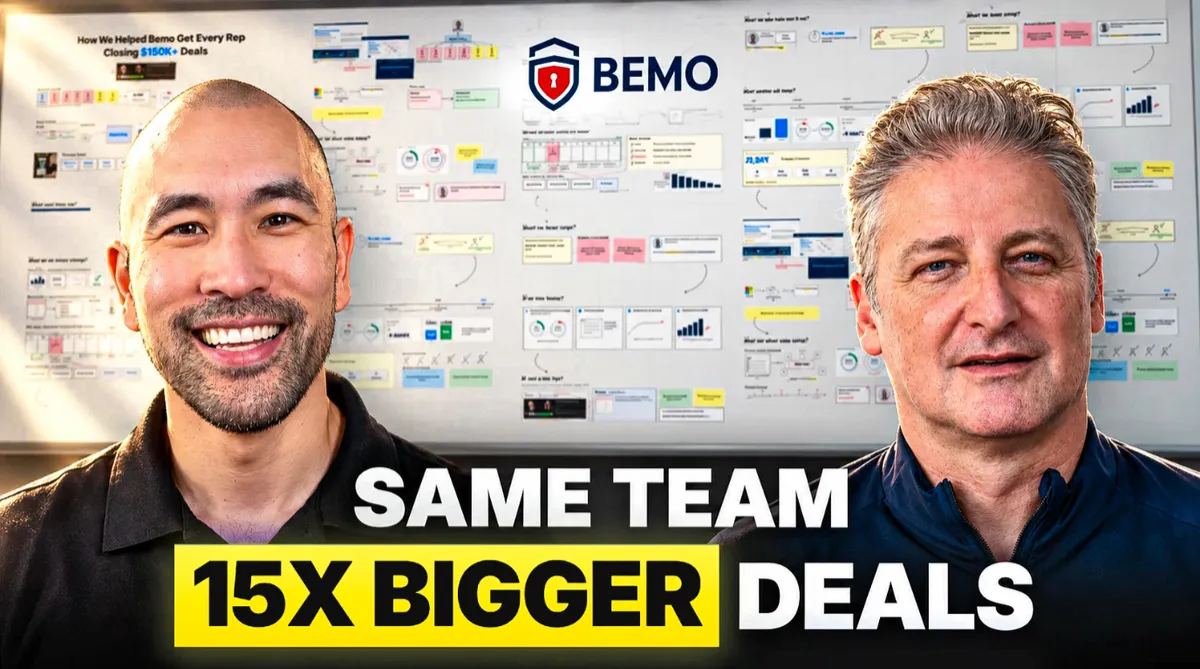
Bemo Breakdown: How Every Rep Started Closing $150K+ Deals
Company | Bemo, a cybersecurity and compliance company selling to small and mid-size businesses |
Team | A sales director, four reps and two BDRs |
Starting point | $10M in revenue. Won 5 to 8% of deals over $150K |
Result | 20 to 25% win rate on big deals. Average deal from $19K to over $300K. Revenue to $16M |
Timeline | First big deal in about 90 days. Closing them consistently by month six |
Why do sales reps only close small deals?
Most teams run a six-figure deal the same way they run a small one. Big deals need deeper discovery and a plan to keep many buyers engaged over a long cycle. At Bemo, fixing those two gaps lifted the win rate on $150K+ deals from 5-8% to 20-25%.
Want the story in Bemo’s own words? Watch the full Bemo interview.
The situation
Bemo is a cybersecurity and compliance company that sells to small and mid-size businesses across the US. Bruno Lecoq is the CEO, and Brandon, his sales director, runs the team.
They had plenty of good inbound leads, and a big share of them came through Microsoft, so the team rarely had to chase a deal. Their reps were great at small deals, around $19,000 each.
When we met, Bruno had just made a big call. The small deals didn't leave enough margin, so Bemo was moving into compliance work, where deals run six figures and took 6 to 12 months to close.
The challenge
Bigger deals sell differently, and nobody had planned for that. Bemo's reps ran every deal the same way, big or small, like an order to fill. Good inbound leads train a team to do that.
On small deals, they won about 25% of the time. On deals over $150,000, they won 5 to 8%. Those deals had more people involved and more steps, so every big deal was a guess.
The small deals kept the overall win rate looking healthy, which is why the problem was easy to miss. It only showed up once we split win rate by deal size.
The stakes were high. Bruno told me that without this change, they'd be out of business.
What they'd already tried
Bemo tried to build the big-deal process themselves first. It didn't get them there.
What we found in the first 30 days
We went through their sales data and call recordings, talked to every rep and got the whole team set up. The goal of that month was to find the one thing holding them back most, before we trained anything.
For Bemo, it was discovery, the first conversations where a rep learns what the buyer needs. Their reps asked questions to fill an order. A six-figure deal needs questions that find a business problem worth paying to fix.
The second gap was keeping a deal alive across a lot of people over a long cycle.
What we changed
From week two: live deals. We worked their stalled six-figure deals with the team every week. On each one, we fixed the discovery, the next steps and the proposal. We also helped the rep get in front of more people at the account, which is called multithreading.
At the same time: one playbook, one set of stages. Every rep got the same discovery playbook. The team changed its CRM stages to match the eight phases a complex deal actually goes through, so each deal gets updated against the step it really needs.
After three months: one phase at a time. We fixed the process phase by phase, starting where deals stalled most. The team was solid on phases one and two, and a lot of deals stalled in phase three. So we spent a quarter on phase-three calls, and the next quarter on phase four.
Later: the back half of a big deal. The goal of each meeting, how to structure the proposal, how to run in-person meetings, and exec matching, where you bring one of your executives to meet theirs.
The side effect was a pipeline anyone could read. Everyone in sales and marketing uses the same eight phases now. When Bruno opens the pipeline, he knows how many deals sit in each one.
Does your team win the small deals and lose the big ones? Book a Revenue Strategy Call.
What the team put in
Bruno handed sales to Brandon and held him accountable for the result, without micromanaging him. Brandon and the reps spent about two hours a week with us in the live deal sessions, and they brought real deals every time.
Only one rep pushed back. He was a bit overconfident and didn't trust outside trainers. About three months in, once he saw the rest of the team winning, he changed how he worked and started getting results too.
The results
Month 3: the first big win, a $150,000 deal. The small deals started closing more often at the same time.
Month 6: the team was closing six-figure deals consistently, right as they moved into the new market.
Year 1: they phased out the small deals. The average deal was $150,000.
Today: the average deal is over $300,000. Big-deal win rate is 20 to 25%, and those deals close in about four months.
Early this year: a $1.2 million deal, the biggest in Bemo's history. It took eight months, more than 40 Teams meetings, more than 30 calls and a proof of concept. Exec matching was a big reason it closed.
Metric | Before | After |
|---|---|---|
Win rate on deals over $150K | 5 to 8% | 20 to 25% |
Average deal | $19K | Over $300K |
Big-deal sales cycle | 6 to 12 months | About 4 months |
Annual revenue | $10M | $16M |
Core team | Same | Same |
They're more profitable than they've ever been, because big deals carry better margins and those customers stick around.
How do we know the system did this? Every rep on the team closes these deals now. The average deal kept climbing after we stepped back. And even the rep who doubted us changed how he sells.
The honest part
One thing that helped had nothing to do with us. Going after compliance work was Bemo's call. Our job was helping them sell those deals.
Two things were harder than expected. Money was tighter than we knew, because they hadn't told us at the start that the small deals were hurting their profit. And it took two years instead of the one they'd planned.
Bruno told me the sales team was down more often than up in that stretch, and some people lost faith. He could have fired the whole team and started over, which would have taken longer and might never have worked. He backed them instead.
For this to work, you need a leader who backs the team for the long haul, and a team that wants to learn the system.
Is this your team?
The gap. Pull your win rate on small deals and on your biggest deals. At Bemo it was 25% against 5 to 8%.
Order-taking reps. If your inbound leads are good, your reps may never have had to run a long deal with a lot of people in it.
Stalls with no clear reason. That usually means the rep is guessing at the next step.
Growth without profit. If most of your revenue comes from lots of small deals, you can grow and still feel squeezed.
Frequently Asked Questions
My reps are good. Do I need to replace them to win bigger deals?
Bemo did it with the same core team. Even the rep who doubted the work changed how he sells.
We already tried building our own process. Why would this be different?
Bemo tried too. Here, the coaching happened on live deals from week two, so the reps saw wins while the system was still being built.
How much time does this take from my team?
At Bemo, the sales director and reps spent about two hours a week in live deal sessions. The work happens inside deals your team is already running.
Will this work in my industry?
Everything we build comes from your own calls and your own data, so it fits the way your buyers buy. We've run the same system in cybersecurity, K-12 education, enterprise services, energy, hardware and commercial pest control.
How fast will we see results?
Stuck deals usually start moving inside the first 30 days. Bemo's first big deal closed in about 90 days, and the team was closing them consistently by month six.
What if it isn't a fit?
Your first 30 days are built so your downside stays small. If by day 30 it doesn't feel like a 9 out of 10 to you, you stop there and keep all the work we've done.
Who is this for?
Owners with between 3 and 20 reps, whose leaders and reps will show up to the weekly sessions. If you're an individual rep looking for coaching, or you want a one-day motivational training, we're the wrong people.
If your team wins the small deals and loses the big ones, book a Revenue Strategy Call below. We'll look at where your number comes from and what we'd fix first.
Marcus Chan is the founder and CEO of Venli Consulting Group. Venli helps founder-led B2B companies build a sales system their team can run without the founder on every deal. Before Venli, Marcus led a 110-rep, $195M sales org at a Fortune 500 company. He is the author of the Wall Street Journal and USA Today bestseller Six-Figure Sales Secrets, a 5x Salesforce Top Sales Advisor and a 6x LinkedIn Top Voice. Venli has served 700+ clients.



Mail
Facebook
LinkedIn
X
Pinterest
Snapchat
Reddit